- Sunday, January 17, 2010, 19:27
- Articles
- 865 views
“The journey of a thousand miles begins with a single step.”
I begin with this quotation as I firmly believe that we can achieve sustainable development through simple steps taken at the local and individual level.
Many people overemphasize the importance of global community effort and measures at the macro ...
Full story
- Monday, February 9, 2009, 10:51
- Articles
- 1,378 views

ox•y•mo•ron n. A rhetorical figure in which incongruous or contradictory terms are combined. For example: deafening silence, mournful optimist, blank copy.
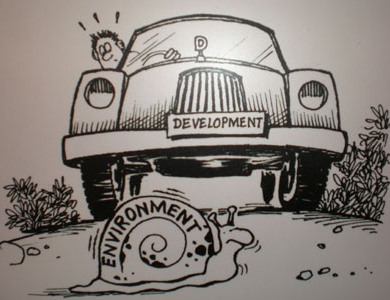
Some “experts” would want to add the phrase sustainable development to the above list of examples. Such critics of the concept of sustainable development also suggest that it should instead be termed as “sustainable de-growth”, since they believe that environment and development (or growth) are antithetical to each other; that is, environment degradation is the price that needs to be paid if development is to be achieved.
Deteriorating environment is often linked with increasing economic activity, requiring deforestation, energy consumption etc. “Development” is usually held responsible for environmental damage, while environmentalists are accused of being “anti-development”! Even a popular economic concept, such as the “Environmental Kuznets’ Curve” suggests that environment degradation increases, with an initial rise in per-capita income, and later decreases with further development.
However, to view environment and development as antagonistic terms is to have a very narrow viewpoint. Once the perspective is broadened, development and environment can be seen as complementing each other.
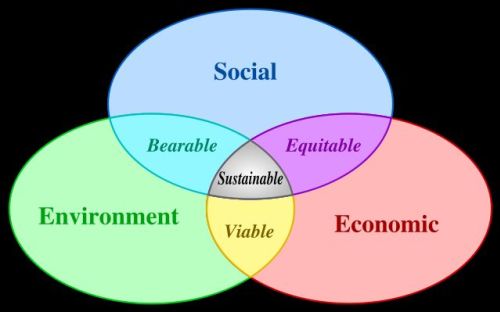
Sustainable development is a pattern of resource use that aims to meet human needs while preserving the environment so that these needs can be met not only in the present, but in the indefinite future.
In other words, development that meets the needs of current generation without compromising the needs of future generations is termed as sustainable development (as defined by the Brundtland Commission). Thus, when development is viewed in terms of “quality of life” and not mere “numbers”, the complementarity between environment and development comes to the fore.
To refute the notion that environment degradation is a necessary condition for growth and development, I suggest two propositions, which assert that environment and development can, and should exist simultaneously.
Firstly, development can help conserve environment. Thus, both growth and environment conservation can be achieved together.
Constructive intervention can help enhance the quality of environment; and development facilitates constructive intervention. Thus, development can not be provided as
Full story
- Wednesday, December 24, 2008, 9:39
- Articles
- 2,353 views
My exams concluded recently, and the whole process, apart from making me dizzy (!), led me to think about the issue which stares us in our face, yet gets unnoticed so easily: paper wastage.
All of us are aware that the ultimate source of paper is the forest. There is a direct correlation ...
Full story
- Friday, November 28, 2008, 21:06
- Articles
- 2,699 views

Parul Gupta is a student of Economics at Lady Shri Ram College, University of Delhi
Ecology and Economics are closely related issues. Being a student of Economics, I’ve studied that inclusive development is not possible without adequate emphasis on environmental protection. Development and environment need to be seen as complementary, not antagonistic terms. After all, if there is no Earth left, where will development take place?!
Today, when the world is facing the harmful consequences of global warming and depletion of resources, environment conservation has become a topic of global significance, not just an issue with local importance. The matter is of paramount relevance in a developing economy like ours, as environment degradation drastically offsets improvements achieved by economic prosperity, apart from having serious implications for distributive justice.
In my view, although the issue has gained more importance in today’s grave scenario, environment conservation is still a neglected sector, with excessive emphasis on ‘growth’ in terms of numbers, without focusing on ‘development’ in terms of quality. Improper implementation of policies, coupled with indifferent attitudes of authorities has accentuated the ineffectiveness of environment strategy in India.
Full story