- Sunday, May 16, 2010, 11:42
- Articles
- 930 views

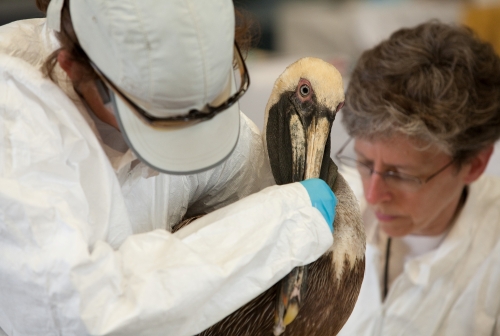
A Veterinarian at Tri-State Bird Rescue examines a brown pelican as response work to the Gulf of Mexico episode. Image © BP p.l.c.
“Aaww…it hurts!!”…that’s what I thought the earth would say to the entire disturbing phenomenon happening on it. Recently breaking news from the US broke my heart and I believed many others who love nature. British Petroleum (BP), one of the world's largest energy companies, providing its customers with fuel for transportation, energy for heat and light, retail services and petrochemicals products for everyday items, became the culprit of environmental havoc in the Gulf of Mexico.
It is reported that the mischief happened due to failure of the blowout preventer to seal the well when trouble brewed. The function of the blowout preventer which is a heavy duty piece of equipment mounted on the top of the well is to jam shut the well to prevent a blowout. The culprits besides BP on the business list includes Transocean, a well-qualified and experienced offshore drilling firm, and other companies involved with the operation of the rig and installation and the operation of the blowout preventer.
The scariest news is about the unpredictable impacts of the disaster, the cost and time to recover from it. No wonder, BP’s chief executive didn’t know what or who could challenge their future plans during his discussion as part of the information reviewed and reported on by Ernst & Young (as part of BP's 2009 sustainability reporting).
“Q. So, what is BP doing to meet future energy demand for oil and gas?
Tony: Our analysis indicates the world has enough proved reserves to last for about 40 years for oil and 60 years for gas, at today’s consumption rates. There is also a lot more oil and gas to find - but it requires working at the industry’s frontiers and continuing to innovate in our technology and processes, as indeed BP has done through its 100 year history. Our progress in deepwater exploration is a good example. Last year we made the Tiber discovery more than ten kilometers beneath the Gulf of Mexico. That’s further below sea level than the top of Mount Everest is above it.
That oil is in a geological layer, the lower tertiary, which we are only now starting to map and understand. We are also pioneering new technologies – such as digital imaging of reservoirs and advanced drilling techniques – to access gas that is locked in dense rock formations. We’re also getting more oil and gas out of mature fields. The average recovery rate from a reservoir is about 35%, but in our Prudhoe Bay development in Alaska we now expect to recover around 60% of the oil as a result of our enhanced oil recovery processes. “
One reporter has creatively termed the havoc as an "Oil Volcano" likening it to magma coming out of the earth which cannot be stopped. Talking of volcano,
the recent horrific Icelandic volcano haunts my mind again. The volcano which remained dormant for 200 years finally erupted ripping a 1 km-long fissure in a field of ice. The volcano released lava a hundred meters high, Icelandic airspace was closed, flights operation was disrupted, many roads were forced to close and around 500 people were moved from the area. Till now there isn’t any exact calculation on the environmental impacts of the eruption.
Full story