
Growth Without Breath is Not Development
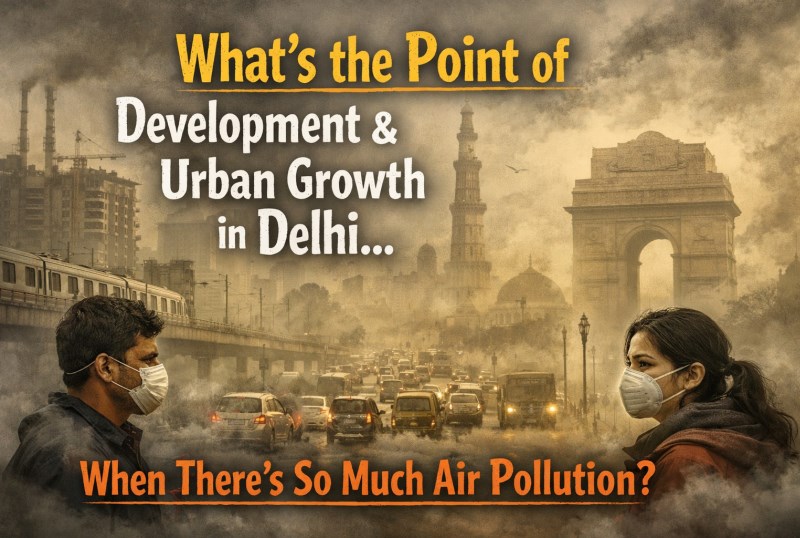
Delhi today stands at a crossroads where every breath matters. Once known for its gardens and tree-lined avenues, Delhi is now better known for choking smog, stinging eyes and lungs that struggle through each passing winter. In this reality, it is no exaggeration to say that every tree in Delhi has become priceless. We often talk about green cover in percentages and hectares, but it is now about the number of individuals they support to breathe. Each tree that makes up the green cover is a living, breathing ally in our fight against air pollution.
Every tree in Delhi today matters, there is no such thing as an unimportant or expendable tree. Each one filters dust, absorbs harmful gases, releases oxygen, cools the air and silently works day and night without salaries, electricity or maintenance contracts. In a city gasping for clean air, trees are our most reliable, maintenance-free air purifiers.
Clean Air Comes First
Trees offer many benefits: groundwater recharge, soil protection, shade, biodiversity, and shelter for birds & insects. These are invaluable. But let us be honest to ourselves, we cannot enjoy any of these if we cannot breathe. Clean, breathable air is not a luxury, it is the foundation of life itself. When a tree is cut, it is not just wood that is lost. It is a few more breaths of clean air taken away from our children. It is a silent reduction in the city’s life-support system.
That is why every tree felled in Delhi should be treated not as a routine administrative act, but as a death in the family. It should be ceremonially mourned, deeply questioned and permitted only when there is absolutely no alternative. If a tree must be cut, the decision should weigh as heavily on our conscience as any irreversible loss of life.
Rethinking “Development”
It is often said again that trees must make way for roads, buildings, and infrastructure. But this reflects short-sighted thinking, driven by convenience and mindless planning rather than wisdom and vision. Development that steals our breath is not progress, it is self-destruction. Is it truly better to gain a few days of extra sunshine in a small patch of land if it costs us years of healthy breathing? Is an extra building in an already polluted neighbourhood or wider avenues worth narrower lungs?
One does not bite the hand that feeds. And we must not destroy the green lungs that allow us to live. Before planning any project that involves tree cutting in Delhi, we must pause — not once, but many times –and ask: Is there any way to accommodate this tree instead of removing it? Cities across the world, especially in developed nations that we aspire to be, bend roads, redesign footpaths and alter plans to protect trees. It is time we learn to do the same.
Trees as Living, Spiritual Guardians
In Indian culture, trees have never been just “resources.” They have been sacred companions, worshipped, protected, and revered as guardians of life. Perhaps it is time we return to that wisdom — not out of sentimentality, but out of survival.
Let us pray to our trees, not in ritual alone but through action: by protecting them, defending them, and caring for them. Anyone who looks closely at Delhi’s trees today can see thick layers of dust settled on their leaves, dust that would otherwise be deep inside our lungs. The least we can do is to clean their leaves, water their roots and shield them from harm.
Even pruning should be done only when necessary. A tree’s full canopy is its strength; stripping it weakens its ability to protect us.
Not Charity, Self-Preservation
Saving trees is often portrayed as a selfless, noble act. In truth, it is an act of enlightened self-interest. We are not protecting trees for their sake alone, we are protecting them so that we, and our children, can stay alive and breathe clean air.
Machines that clean air are expensive, energy-intensive, limited in reach and full of hidden costs. Trees, on the other hand, stand everywhere, work continuously, and ask for almost nothing in return, except the dignity of being allowed to live. And when we allow them to live, we are only allowing our own children and elderly to live better and ensuring our own health when we reach old age.
Delhi does not need fewer trees trimmed to convenience. It needs every tree it still has, standing tall, filtering air, and guarding our future. If we truly wish to breathe better tomorrow, we must begin today by letting go of selfishness, abandoning shallow planning and making space in our city and in our hearts for every single tree. Let no tree be felled in Delhi at least until we have improved our air. Because when the trees breathe, Delhi breathes.