
How Sustainable are Green Roofs in Indian Cities
Urban regions have a key role in employment, economic growth and the development of the country. But the speed and the scope of urbanization are presenting pressing issues and is threatening environmental sustainability. Some environmental problems caused by fast urban growth include air pollution, global warming, urban heat island effect, noise pollution, flooding and biodiversity loss. These issues affect the physical, mental and psychological well-being of individuals. We need to explore sustainable solutions to overcome these urban challenges. Green roofs is one such sustainable solution to reduce the impacts of ongoing urbanization.
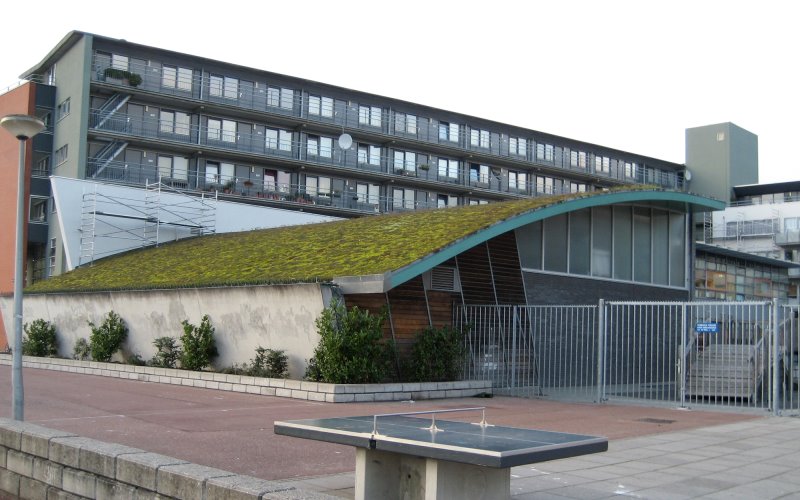
A green roof is a roof surface covered with soil and vegetation; it usually consists of plants, grasses, or small shrubs. Green roofs have been part of human history, they gained popularity in European countries in late 1970s and later spread to other parts of the world. A green roof system includes several layers such as vegetation, growing medium, waterproofing layer, root barriers, insulation and drainage system. Together, these layers function in a same way as a natural landscape. Some advantages of green roofs are discussed below:
Reduction of heat island effect
The temperature in urban core areas is often 1°C to 4.5°C higher than surrounding regions. It occurs due to the factors such as dark asphalt roads, concrete buildings, lack of vegetation, industrial activities and heavy traffic. The heat gets trapped between buildings and other heat-absorbing materials. By converting these heat absorbing surfaces into green roofs, we can reduce such an urban heat island effect.
Trapping dust and air pollutants
Green roofs act as natural air filters. Both plants and shrubs have the capacity to take in certain amounts of the harmful element that are present in the air, and then they are able to alter these elements into organic matter and hence creating sustainable and healthy environment.
Reduction of ambient and indoor temperature
The vegetation present in green roofs act as a natural temperature regulator, providing a cooler and more pleasant environment in urban environment. Green roofs improve internal environment by lowering temperature inside buildings during summer and protecting from temperature fluctuations. This also helps in saving the energy cost.
Reduction in urban flooding
Green roofs help manage rainwater by temporarily keeping it within the soil where it is absorbed by the vegetation. This reduces the risk of surface runoff and lowers the risk of urban flooding during heavy rainfall. Green roof systems are carefully installed to ensure that excess rain water does not accumulate and affects the structural safety of the building.
The advantages of green roofs go beyond their aesthetics. This climate-sensitive approach can be seen in practical applications across India. At the ONGC Green Hills campus in Dehradun, the green roof has been designed using grass, creepers and Sedum plants. This helps in reducing surface temperature by 10–15°C during peak summer and absorbing good amount of rainwater during monsoon which reduces runoff and improves indoor comfort.
Similarly, the CII–Sohrabji Godrej Green Business Centre in Hyderabad shows how green roofs can work in warm and semi-arid climate. The building’s roof has vegetation area with solar panels which reduces heat gain, lowers cooling demand and improves rainwater management. These examples show that green roofs can work effectively across India’s extreme weather conditions if designed carefully.
Green roofs may pose challenges that need to be studied before advocating their long-term use. Issues such as roof seepage, dampness, fungal or mould growth are quite common in regions with high humidity. These problems can be solved by using good quality waterproofing layers, root barriers and efficient drainage system that prevent water stagnation. For early identification of leakage or fungal growth we need to have regular inspection.
North India faces extreme climatic conditions which requires special focus while designing green roof. During summer, green roof reduces direct solar radiation, limits indoor temperature, manage heavy rainfall and lowers cooling demand. And in winter, green roofs can help in reducing daily temperature fluctuation and limit the heat loss through the roof by acting as an insulating layer. However, poorly planned green roofs may block the sunlight and lower the temperature.
This can be addressed by using shallow soil layers, partial green roof coverage and proper plant choice. Native hard plants such as Sedum, Portulaca (Moss Rose), Aloe vera and doob grass are suited for Indian conditions. These shallow rooted plants help reduce structural load and moisture retention which lowers the risk of seepage and fungal growth.
Green roofs can be a practical solution for improving urban sustainability if they are designed as per local climate. Limited case studies shows that green roofs can reduce heat, manage rainwater and temperature fluctuations. However, issues like waterproofing, dampness, fungal growth and heavy monsoon rainfall must be addressed. With proper planning, suitable plant selection and regular maintenance, green roofs can be an effective and realistic strategy for urban sustainability in India.