
Rural Kitchens Need a Climate Breakthrough
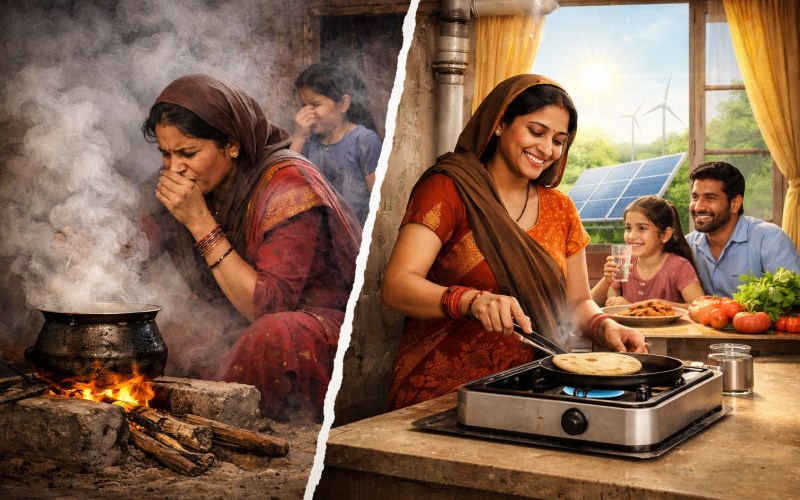
Nearly one-third of the world’s population still cooks on traditional stoves using biomass (agricultural residue, animal dung, firewood, charcoal), kerosene and coal. The resultant household air pollution from the incomplete burning of polluting fuels releases particulate matter (PM2.5), carbon monoxide (CO) and black carbon, among other harmful pollutants. This has implications for human health and well-being, environment and climate.
Despite black carbon (the second-most important climate pollutant after carbon-dioxide) emissions from incomplete combustion of biomass, cooking with polluting fuels is an oft-overlooked critical contributor to climate change. It is important to note that household air pollution is a significant contributor to ambient air pollution. Conversations on climate breakthroughs often focus on renewable energy, electric vehicles, or carbon markets. While these are crucial levers to lower emissions, they are only one of many potential solutions. To build a comprehensive climate agenda, household cooking energy must move from the margins of development discourse to the center of climate policy.
A Hidden but Significant Climate Burden
In many parts of the world, cooking fires double as invisible engines of warming. Biomass fires release thick smoke that traps heat far more efficiently than carbon-dioxide (CO₂). In addition to interfering with weather patterns, this damages ecosystems’ capacity to preserve biodiversity and capture carbon. At the same time, women and children spend hours gathering firewood, reinforcing cycles of inequality, and reducing opportunities for education and income generation. What begins as a household necessity expands into a global climate challenge with ripple effects that intensify health burdens, degrade forests, and slow progress toward sustainable development goals.
Why Rural Kitchens Deserve Climate Attention
Most clean cooking initiatives primarily focus on the link between household air pollution and health outcomes. According to the World Health Organization, household air pollution is responsible for 3.2 million premature deaths every day. However, limiting the clean cooking discussion to health alone has kept inefficient cooking out of mainstream climate discussions.
The climate case is equally urgent. Black carbon disappears from the atmosphere quickly (in other words, it is a short-lived climate pollutant), but has significant impacts on the climate, snow and ice, agriculture and human health. Cleaner cooking alternatives have the potential to deliver relatively fast climate payoffs while improving human well-being and restoring ecosystems.
From Welfare to Climate Priority
It is estimated that energy transition in line with India’s net zero goals by 2070 requires capital inflows of over USD 10 trillion. Much of this financing will be directed at large-scale energy transitions. Smaller, household-level interventions like clean cooking can deliver tangible, rapid, and affordable benefits across multiple domains.
Yet climate finance flows rarely prioritize household energy. Rather than mitigation, clean cooking is often treated as welfare. Linking it to carbon markets and re-framing it within national climate commitments could change that dynamic. Recognizing rural kitchens as climate infrastructure would put them at par for the same seriousness of investment as transport systems or grids.
An Overlooked Opportunity
Rural kitchens are unique in that there are already encouraging signs. Better LPG, biomass stoves, ethanol, solar cookers, and biogas, all offer the potential to reduce emissions in terms that meet cultural as well as practical requirements. It isn’t a question of whether the technology exists, but how to deploy it in large numbers and get households to use them consistently and in a sustained manner.
Some solution tracks that emerge follow:
- Supply Chains and Distribution: Scaling depends on consistent networks of production, maintenance, and fuel supply. Rural retail systems, cooperatives, and local entrepreneurship can be instrumental in providing sustained uptake.
- Financial Models: Clean cooking can be made affordable through using carbon markets and climate funds. By pricing reductions in household emissions, communities can access credits or subsidies that reduce the cost of transition.
- Behavioural Adoption: Trust and awareness are as important as technology. Campaigns that emphasize dignity, health, time savings, women’s empowerment in addition to climate advantages can render cleaner choices aspirational and sustainable.
Rather than large-scale climate projects, these solutions directly address household issues, improve lives immediately, and can be replicated across geographies with modest investment. This is why rural kitchens are one of the most effective and practical levers for near-term climate progress.
The Way Forward
The journey to net zero cannot leave any sector behind. The world is going to have to think and get beyond mega projects and markets if it hopes to hit its climate goals A genuine climate breakthrough will not only be technological, but visionary in recognizing the value of small, daily changes with a ripple effect into communities, forests, and the atmosphere.
Rural kitchens might not make climate headlines, but they are the most immediate means of reducing emissions and improving lives. By shifting cooking in the home into climate action, leaders can unlock a solution that is scalable, practical, and profoundly transformative. Investing in the quiet revolutions that are happening around the kitchen fire can be foundational to the climate action.