
PM Addresses NGT Conference on Future of Environment and Climate Dynamics
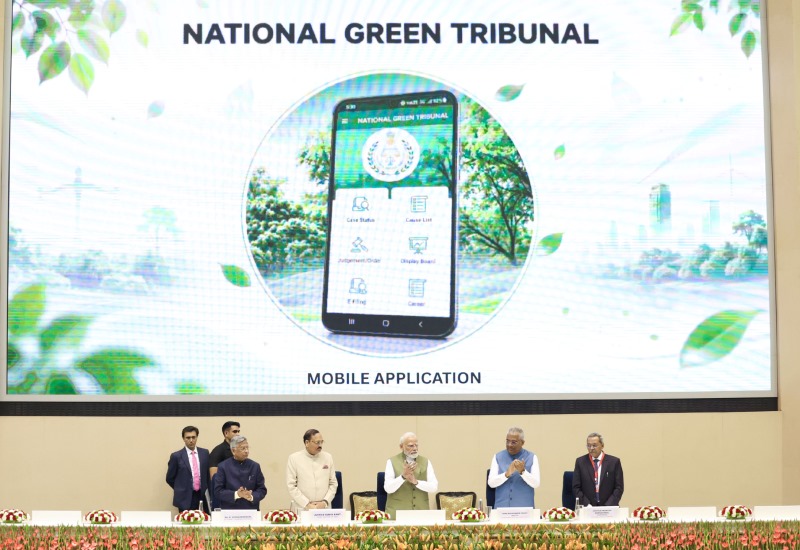
The Prime Minister of India Narendra Modi addressing the International Conference on The Future of Environment and Climate Dynamics in New Delhi on 19 September, 2026.
Prime Minister Narendra Modi emphasized India’s deep-rooted cultural and historical connection with nature, highlighting how traditional wisdom is guiding modern climate solutions and inspiring global environmental action. He praised the National Green Tribunal for its contribution and asserted that India is emerging as a global leader in addressing climate challenges.
 Addressing global inequalities in carbon emissions, he noted that developed countries emit up to six times more carbon per capita than India, despite developing nations often facing greater scrutiny. He highlighted India’s leadership through international initiatives such as the International Solar Alliance, One Sun, One World, One Grid, the Global Biofuel Alliance, CDRI and the International Big Cat Alliance.
The Prime Minister outlined India’s significant progress in renewable energy, stating that the country achieved its COP-21 commitments ahead of schedule. Solar capacity has increased from just 2 GW to over 160 GW in approximately 12 years. Initiatives such as the PM Surya Ghar Muft Bijli Yojana have enabled solar installations in over 50 lakh households, while the PM-KUSUM scheme has provided solar pumps to 30 lakh farmers. Wind, hydro and nuclear energy have also expanded, nearly quadrupling India’s non-fossil energy capacity.
Highlighting sustainable transportation, the Prime Minister announced the launch of India’s first hydrogen-powered train, described as the world’s longest. Electric vehicle adoption has increased approximately 950 times, while metro networks have expanded from five cities in 2014 to more than 20 cities today, covering over 1,000 kilometres. Railway electrification, Dedicated Freight Corridors, FASTag and nearly 5,000 kilometres of operational inland waterways have further reduced fuel consumption, emissions and transportation-related pollution.
On water conservation, he highlighted the construction of over 70,000 Amrit Sarovars and 1.5 crore rainwater harvesting structures. Efficient irrigation practices are benefiting more than 2 crore farmers. The promotion of water-efficient millets (Shree Anna) has increased domestic production and exports, while supporting sustainable agriculture and inspiring the International Year of Millets in 2023.
The Prime Minister also highlighted 24,000 natural farming clusters covering 12.5 lakh hectares, the development of 3,000 climate-resilient crop varieties and the promotion of agroforestry. India’s very dense forest cover has increased by over 22% in the past 12 years, supported by initiatives such as ‘Ek Ped Maa Ke Naam’.
Addressing waste management, he reiterated the ban on single-use plastics and emphasized the transition towards a circular economy based on reducing, reusing and recycling waste. The Gobardhan Yojana was highlighted as an example of converting organic waste into valuable resources.
The Prime Minister concluded by stressing that India’s environmental achievements contribute not only to national development but also to humanity’s collective future. He reaffirmed that economic growth and environmental protection can progress together, expressing confidence that India will continue building a responsible, inclusive and sustainable future.