Archive for August, 2009

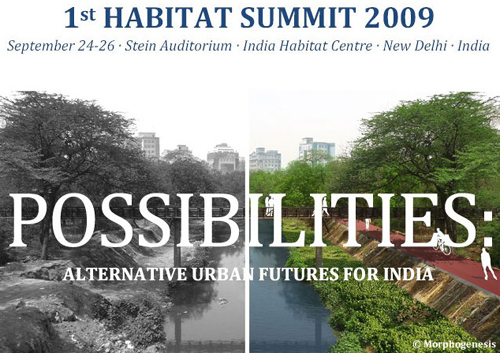
Fellowships Available: The 1st Habitat Summit ‘Towards Alternative Urban Futures for India’

The 1st Habitat Summit at IHC

The Urban Habitats Forum (UHF) is a public awareness platform established by Mirabilis Advisory in partnership with India Habitat Center, and designed as a collaborative network of multidisciplinary thinkers and change-makers to push for innovation in shaping the next generation of cities in India. The forum aims to mobilise action through intelligent discourse, impactful research and result-driven advocacy.

Underpinning its commitment to developing an alternative urban vision and agenda that considers liveability and sustainability as key parameters for success in the development of India’s cities, the Forum is co-hosting the first ‘Habitat Summit’ with the India Habitat Centre from September 24-26 2009.

In order to make the Habitat Summit democratic and have a wider reach, the UHF is inviting youth between the age of 18 and 35 years to apply for the Urban Habitats Forum Fellows Programme. The Fellowship programme offers 100% scholarship to selected students and young professionals.

Click here to read more to download the application form. Last date for applying is 10th September, 2009.

Comments (4)

Introducing: New Legal Bio-Way to Cut Your Electricity Bill By 70%

Karma PaljorEditor’s Note: Guest post, cross-posted from IBNLive. Karma Paljor works with Network 18 and is the face of news on CNN-IBN. When not on TV, he can be found at an airport near you, remotely flying his planes over the Delhi sky!

Election gone, subsidy gone. Like everything you will now have to pay more for power. In future, if things go this way, electricity will perhaps constitute about 40% or even more of your home operating costs.

So, if you are one of those into heavy forward planning you will perhaps invest in non conventional modes of energy. I found this rather interesting piece of equipment that immediately helped me lower my electricity bill by over 70%. The best part is that I invested just under Rs 200; could have been cheaper had I bought it off the street.

It’s also brought me tremendous joy. Immediately, after I had installed my Cut Electricity 1.0, the bio mechanism kicked off, it was alive in a day or two. Caution: the bio machine does not show immediate results it requires an incubation period of over 15 days to a month.

Cut Electricity 1.0 Karma

Cut Electricity 1.0

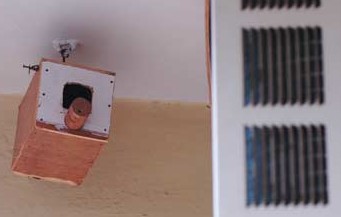
I invested in one of those and it was never intended for the purpose it served later. I bought a clay bird house and without much thought hung it next to my air conditioner. Before I could realise my blunder, I found tenants, who immediately moved in and started a wonderful family.

I have not been able to find out much about their species, but they are wonderful. The kids are growing and demand a lot from their parents, create a racket sometimes. I am posting the pictures and seeking help from my ornithology friends to identify the species.

Read the rest of this entry »

Comments (1)

It’s All About Water Now, For Today and Tomorrow

Water water nowhere, what to drink?

It’s all about water!

August 30th, 2009:

Rajender Singh and Delhi citizens come together to initiate the Dilli Jal Biradari (DJB) – the Delhi chapter of Jal Biradari!

Comments

Kapil Sibal Talks Education for Sustainability

Editor’s Note: The following was circulated by Dr. Susan Sharma of the Indian Wildlife Club

Tlak by Kapil Sibal at NMML

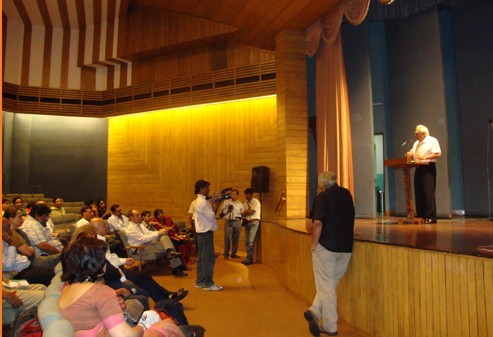
The talk given by Mr. Kapil Sibal, Union Minister for Human Resource & Development on the 29th of July 2009 at Teen Murti House, was really ‘manna’ to an Environmentalist’s ear. The crux of his talk was that ‘Environment Education’ should be at the center of education, all other knowledge can follow. All scientific data and processes are available with Nature.

“Bring science into education; all aspects of science can be learnt from nature. Science taught in correlation with nature is understood best.”

“Education for sustainable development in an era of climate change, calls for a change of mindsets. The need is to reach out to communities and have a dialogue. Teachers within the community will have knowledge at ground level”.

” Teaching of a subject must be holistic. Environmental issues can be effectively linked to say, automobile engineering. Teaching of music can take off from nature….”

” Communicating with nature creates a sense of preservation of nature at the heart of education…”

“The Government’s aim is to connect all villages of India in the next three years. This can lead to leapfrog in education. We must be ready with relevant content in the meantime.”

Heart of all content is nature!

Previously on Delhi Greens:

Comments (1)

Following Rules and Taking Responsibility

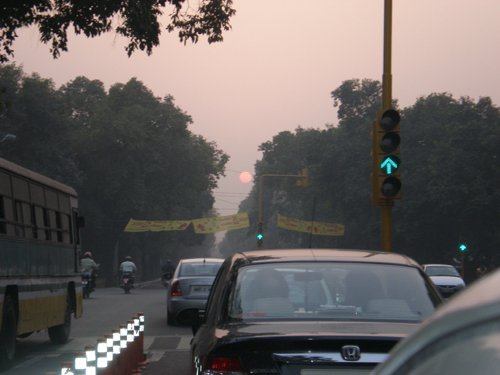
Traffic jam near patel chowk
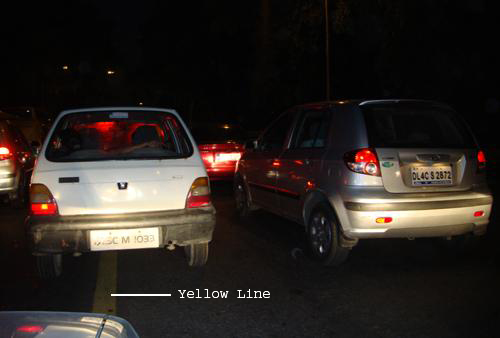
This, and not just the rains, causes traffic jams across Delhi

Bunking school, how many of us have not gone to school for no reason at all? Or after giving reasons like ‘don’t feel like it’, ‘there is a test’, ‘I woke up late’ etc. My daughter who is in 10th standard shared with me that every time there is a class test almost all her class mates do not come to school a day before. Once there were only three of them in a class of 50 plus. Given this trend, the school had a rule to enforce attendance. It declared that five marks will be deducted from the marks the student got in the test if the student was found to be absent within three days before the test. Only one teacher implemented it, and she is no longer with the school. So the rule remained in the rule books. The biggest pile of garbage is right under the sign that says ‘do not litter.’

Traffic rules are no exception. There is a rule book that the Delhi Traffic Police has and one traffic policeman was generous enough to hand me a copy, for free! These are universal traffic rules and signage for motorized traffic all over the world. There is a reason for that.

But we do not follow traffic rules. We rarely cross at the zebra crossing. We stop to buy chaat from the street vendor on the roadside creating traffic block. There is always a car coming from the opposite direction while taking a U-turn under a fly over. There is always one vehicle coming at full speed in the wrong direction at any given left turn. We always overtake from the left. We rarely wait for the pedestrian to complete crossing. Rarely do we wait for the traffic light to turn green before we take off. Rarely do we let someone else overtake us. Rarely do we wait for a vehicle at a cross road to let into the traffic before us. We love to break small rules and when caught we would rather pay-up the traffic cop than pay the fine. We begin early in school and carry it out in our every day lives. All this adds on.

Having better roads and more vehicles in a city is not enough to improve traffic flow in the city. Along with it, we need disciplined traffic that follows rules so that speed and efficiency of traffic can be increased.  The first step in improving traffic in our city is to accept that we do not follow rules. We should take full responsibility to the chaos we have on our streets. Without this we cannot even begin to transform our traffic system. As Carl Jung the famous psychologist once said, ‘The most terrifying thing is to accept oneself completely’.

Comments (1)

3Rs For E-Waste

ewaste

In the last twenty years, computers have revolutionized our daily life. In our every day life we use cell phones, sit in front of various screens like our PCs, television sets etc. and use our microwaves and fridges for keeping ourselves well fed quickly. Travel reservations have become so easy with the computers and cellular phones.

The other thing that we do is replace our mobiles, computers, fridges, washing machines etc. more frequently than we need to. My mother uses a fridge she got in 1989, while I have changed 4 since then. I have to have the most recent good looking fridge as my friends have it. I have to keep up with the latest. Same goes for cell phones, computers, stereos and microwaves. This consumerism is great for our city and economy as it increases demand which in turn boosts our economy and maintains a good growth.

But every solution to an old problem is a new problem. This consumerism gives rise to electrical and electronic or the e-waste. It is one of the fastest growing waste stream in the world. It needs appropriate treatment and disposal facilities that we do have in our country, as per the legal requirements. We also have a Law.

What is missing is that there are not enough Kabadiwalas to reuse, recycle and dispose e-waste safely. This waste contains over 1000 different substances. The long term health impact of e-waste is cancer. Why are there not enough Kabadiwalas? Because there is not enough demand for its treatment.

ecycling ewaste

In the past when there were fewer cars in Delhi, old car batteries producing lead were simply thrown away. But over time, when the number of old batteries increased with an exponential increase in the number of cars, there came, Kabadiwalas who processed it to extract lead and which is a ‘dirty’ but lucrative business.

What can we do? What we can do is to recognize this impacts of our actions and overcome the barriers to inventing a future of e-waste free environment. The biggest barrier is peer pressure to buy newer, better, latest things. Second barrier is indifference to the impact or our actions on the environment. The solution, like for any environmental problem, is to reduce, reuse and recycle. We as consumers can reduce. We can postpone decision to buy an electronic gadget like computer, cell phone or its upgrade. It will be cheaper for you. Use the gadgets till they ‘die’. As part of their last rites ask the shop keeper or the Kabadiwala, when he takes it away, how he plans to dispose it off and suggest recycle and reuse of substances extracted from it. Be aware and start asking questions.

Comments (3)

Public Lecture on Niyamgiri: The Last Stand of Niyamraja

Toxics Link’s Environment & Health Public Lecture Series

ToxicsLink Logo

The Last Stand of Niyamraja

In defense of their faith and our collective future, one of the world’s earliest indigenous groups, the Kondhs, in Orissa’s Niyamgiri are fighting to save the Niyamgiri Hills from being dug out for bauxite by a multinational mining giant.

This struggle has taken the voice of a small community that has lived a sustainable life for many generations from the pristine forests of Orissa to the head office of the company in London.

The Kondh tribal worship the mountain as their God and know that its perennial streams and bountiful forests have allowed them to live with dignity for thousands of years. This is in sharp contrast to their fellow tribesmen who live downhill — displaced, battered and poisoned by the pollution from the company’s refinery that is producing aluminum sourced from other parts of the country.

But the conveyor belts from the refinery have reached the foothills of the Niyamraja….The mountain will be turned into a massive pile of rocks, and the dust from these will be turned into chocolate wrappers.

Toxics Link invites all for a panel discussion on the rights of indigenous people and the so called need for development

Panelists:

  • Suma Josan, Indo-American film maker and Activist
  • Ritwik Dutta, Lawyer Activist
  • Bratindi Jena, Head of Tribal Rights work in Action Aid

Moderated by: Professor Virginius Xaxa, Sociologist

Date: 21st August 2009, Friday
Time: 6:30 p.m.
Venue : Conference Room I, India International Centre, Lodhi Road, New Delhi

(In collaboration with India International Centre)

For further information, please contact:
Pragya Majumder – pragya@toxicslink.org
T: 24320711, 24328006
E: info@toxicslink.org

Comments

Safe Drinking Water: Still a Far…

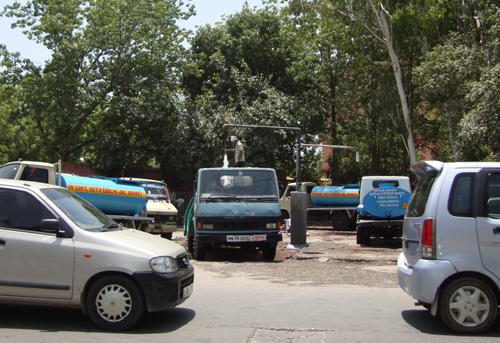
Roadside filling of water tanker

The latest report on Millennium Development Goals (MDGs) says that in South Asia 87% of total population had access to safe drinking water in 2006. Another source (UNICEF Report) confirms that nearly 89% of the people in India have access to improved drinking water resources. This symbolizes a good change in the percentage of people with access to safe drinking water in India than earlier decades.

As a reminder to all, MDGs are internationally accepted eight goals which need to be achieved by 2015. The eight goals are as follows:

  • Goal 1: Eradicate extreme poverty and hunger
  • Goal 2: Achieve universal primary education
  • Goal 3: Promote gender equality and empower women
  • Goal 4: Reduce child mortality
  • Goal 5: Improve maternal health
  • Goal 6: Combat HIV/AIDS, malaria and other diseases
  • Goal 7: Ensure environmental sustainability
  • Goal 8: Develop a Global Partnership for Development

Further, each of these goals have some specific targets and indicators. Here I would like to concentrate on Goal 7 which speaks of environmental sustainability. It reaffirms that all government policies and development programmes should be in tune with this goal i.e. ensuring a sustainable environment for the world. One of the targets of this goal is to halve the proportion of people without sustainable access to safe drinking water and basic sanitation.

Evidently India is doing well in providing access to improved drinking water resources to its people. But the difference between ‘improved’ and ‘safe’ remains unknown. Even today there are villages in several states of India that depend on an unsafe drinking water sources leading to the spread of harmful diseases among the rural population. At the same time, a large number of villages do not have a single drinking water resource within 3-4 km

There has always been a difference between policies and practice, reality and calculation. It is therefore, the vital responsibility of the common people to find out the truth and ask for your rights. To have access to safe drinking water is your right and mine. It is but a basic human right.

Comments (2)

Happy Independence Day 2009!

Happy Independence Day 2009

India EyeDelhi Greens wishes the citizens of India a very happy and pollution free Independence Day 2009, with a hope and vision for a Sustainable India! Download List of Manufacturers Producing Alternate Bags in Delhi

Comments

Good Transport – What Does It Take?

Taking time out while living in a city, to actually read a blog is great. Getting responses from those of you who take the trouble to not only read the blog but take out time to respond to it is always very encouraging. I appreciate the time and attention you so generously give me. I agree we are all struggling to find what is it that we need to do, what action we should take to be more eco-friendly.

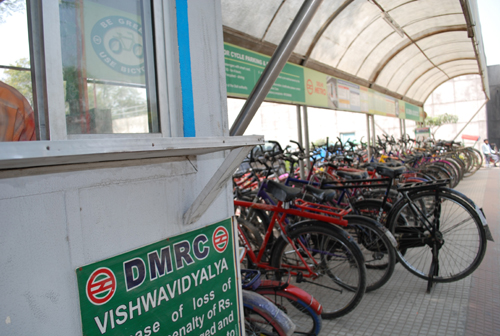
Rent a Cycle from the DU Metro Station

Creating a vision, an ideal transport plan to conform to present and future is the need of the hour. The idea of a larger vision for the future transport sector for a city is a distinct one and a very rational possibility for the city of Delhi. It is relatively easy to plan and implement and can be achieved if a bunch of planners and architects put their heads together. They could put a historical perspective of looking at how the city has evolved and then plan for how it is likely to develop and come up with a very logical plan for the transport sector. The broad brush strokes are easy to draw.

Then comes the real struggle between the city plan implementers like MCD officials, traffic police and every day people. Those who are supposed to use it never seem to conform to the logical expectation of the planners. They seem to do their own things, like jump over the road divider barrier which is otherwise raised to three feet height to stop them from crossing the road randomly. This becomes a continuous and ongoing battle.

This is one way of looking at it. Another way is to pay attention to the detail travel between ‘corridor to door step.’ The broad brush strokes have made it possible to have a metro rail service or new DTC buses as mass transport options and massive parking lots. Thanks to the Commonwealth Games we have it happening quickly. But the journey between the bus stop of the Metro station, to the door step of the commuters’ home is a challenge still. No point of having an efficient mass transport, if the time taken from the home to the station is the same as between one station to the other. It should be as little as possible, ideally less than half.

What is truly needed is to empower and enable people (daily commuters) in fulfilling this short trip that is of interest and importance to them. And in the process transform the city transport sector giving commuters more freedom and peace of mind in their daily commutes. Thus, the real challenge is in efficient planning and management of this last mile connectivity. And this ‘detail’ will have to be planned and worked out in consultation with those who actually use the system.

Comments (1)

Click for New Delhi, India Forecast