
2026 Will Shape the Future of Food, Land and Community
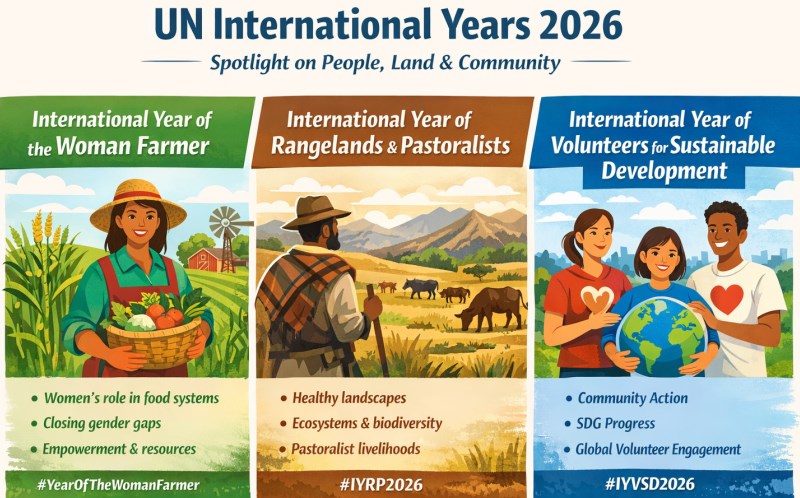
The year 2026 is more than just another milestone on the global calendar. Through the declaration of three United Nations International Years:
- the International Year of the Woman Farmer,
- the International Year of Rangelands & Pastoralists, and
- the International Year of Volunteers for Sustainable Development,
the world is being invited to pause, reflect and act on some of the most fundamental systems that sustain human life. These represent food, land and community and are deeply interconnected. The choices we make today will determine whether these systems become more resilient, inclusive and sustainable in the years ahead.
International Year of the Woman Farmer: Making the Invisible Visible
Women are at the heart of global food systems. Across the world, they plant, weed, harvest, process, store, and sell food, while also managing households and caring for families. Yet, despite their central role, women farmers remain largely invisible in agricultural statistics, decision-making processes, and policy frameworks. The International Year of the Woman Farmer in 2026 aims to correct this imbalance by recognizing women as farmers in their own right.
The relevance of this theme lies in addressing persistent gender gaps in access to land, credit, inputs, technology, training, and markets. When women farmers have the same resources as men, farm productivity increases, nutrition outcomes improve and rural poverty declines. Highlighting women’s roles is therefore not just a matter of equity; it is a strategic investment in food security and sustainable development. Beyond recognition, 2026 also calls for a shift toward promoting women’s entrepreneurship in agriculture. Women are not only farmers; they are potential entrepreneurs, innovators and change-makers in the food system.
In India, this International Year is particularly significant. Women constitute a large share of the agricultural workforce, yet land ownership and formal recognition remain limited. A focused global spotlight in 2026 can help accelerate policy reforms, improve access to resources and strengthen women-led enterprises across India.
International Year of Rangelands and Pastoralists: Valuing Land and Livelihoods
Rangelands cover nearly half of the world’s land surface and support millions of pastoralists who depend on livestock herding for their livelihoods. These ecosystems are home to rich biodiversity and play a crucial role in carbon storage, climate regulation and food production. Despite their importance, rangelands and pastoralist communities are often misunderstood, undervalued and marginalized.
The International Year of Rangelands and Pastoralists in 2026 seeks to change this narrative. It emphasizes that pastoralism is not an outdated or inefficient system, but a highly adaptive and sustainable way of managing fragile ecosystems, particularly in drylands, mountains, and semi-arid regions. Recognizing pastoralists’ traditional knowledge and mobility-based practices is essential for protecting rangelands and strengthening climate resilience.
This theme is highly relevant for India, which has a large number of pastoral and agro-pastoral communities. In states such as Haryana, Punjab, Rajasthan, and Gujarat, and across many other regions, communities like the Raikas, Maldharis and Gaddis have long practiced livestock herding adapted to local ecologies. In the Himalayan region, yak herders play a vital role in sustaining mountain livelihoods and cultures under harsh climatic conditions. Yet many of these communities struggle with shrinking grazing lands, lack of recognition and limited access to services. The global focus in 2026 can help bring long-overdue recognition, policy support and investment to India’s pastoralists and the rangelands they traverse & protect.
International Year of Volunteers for Sustainable Development: Action by Everyone, Everywhere
Sustainable development cannot be achieved by governments alone. It requires the collective energy, creativity and commitment of individuals and communities. The International Year of Volunteers for Sustainable Development in 2026 highlights volunteerism as a powerful force for achieving the Sustainable Development Goals (SDGs), from climate action and education to health, gender equality, and environmental protection.
At its core, this International Year is a call to action. It emphasizes that every individual has a role to play, and that even small, local actions can contribute to global sustainability. Volunteering builds social cohesion, strengthens trust and empowers communities to address their own challenges. It also creates pathways for youth engagement, civic participation and inclusive development. The relevance of this theme is especially strong in a world facing climate change, inequality and social fragmentation.
In 2026, the idea is not just to celebrate volunteers, but to encourage a mindset where every action, at home, at work, and in communities, is guided by sustainability. From reducing waste and conserving water to supporting local food systems and community initiatives, individual choices matter. In India, with its strong traditions of community service, youth movements, and civil society engagement, the International Year of Volunteers for Sustainable Development offers an opportunity to channel collective action toward national and global sustainability goals.
A Defining Moment for the Future
Taken together, the three UN International Years of 2026 point toward a shared vision of the future based on sustainable development. By recognizing women farmers, valuing pastoralists and rangelands, and mobilizing volunteers, 2026 has the potential to reshape how societies think about growth, resilience and responsibility. It is a reminder that the future of food, land and community depends not only on what we produce, but on how and with whom we choose to build it.