
Businesses Urged to Integrate Climate Resilience at TERI SAS Conclave
As climate change intensifies and the world moves beyond several critical environmental thresholds, businesses are facing growing pressure to rethink their approach to sustainability. The challenge is no longer limited to reducing emissions; organisations must prepare for climate-related disruptions, manage resource constraints and build resilience into their operations.
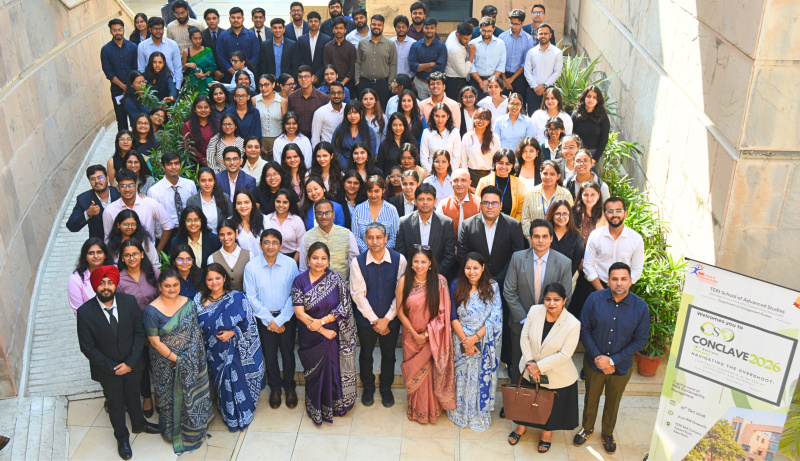
These issues were at the centre of the third Chief Sustainability Officers (CSO) Conclave, organised recently by the Department of Management Studies at the TERI School of Advanced Studies (TERI SAS). The conclave, themed Navigating the Overshoot: Corporate Leadership in an Era of Exceedance and Reversal, brought together corporate sustainability professionals, industry representatives, academics and students to examine the implications of climate overshoot for businesses.
The discussions reflected a growing shift in corporate sustainability priorities. While emissions reduction and environmental compliance remain important, businesses are increasingly required to consider how climate risks affect financial performance, supply chains, infrastructure and long-term business continuity.
The inaugural session featured addresses by TERI SAS Vice Chancellor Prof. Suman Kumar Dhar, Dr. Karan Thakur, Group Vice President – Corporate Affairs and Sustainability at Apollo Hospitals, Dr. Shruti Sharma Rana, Associate Professor and Head of the Department of Management Studies and Col. B Venkat, Registrar, TERI SAS.
Sustainability increasingly linked to business strategy
The first panel discussion, titled “Sustainability as Strategy – Creating Enterprise Value While Navigating the Overshoot”, examined how companies can move beyond treating sustainability as a standalone corporate responsibility function and incorporate it into business decision-making. Panellists discussed the potential of sustainable procurement, supply-chain collaboration, artificial intelligence-driven optimisation and operational improvements in reducing environmental impacts while generating business value.
An important theme was the need to establish a clearer relationship between sustainability investments and financial performance. As regulatory requirements and stakeholder expectations evolve, companies are under increasing pressure to demonstrate measurable outcomes rather than rely solely on sustainability commitments and disclosures.
The panel comprised Dr. Satish Mishra, Chief Sustainability Officer, Trident Group India; Jitaditya Dey, Executive Director, PwC India; Dr. Karan Thakur of Apollo Hospitals; and Sindhu Sharma, Head – ESG and Compliance, Bharti Airtel. The discussion was moderated by Dr. Moumita Acharyya, Assistant Professor, Department of Management Studies, TERI SAS.
Resource efficiency emerges as a key mitigation measure
The second panel, “Operational Efficiency and Excellence – Driving Climate Mitigation”, focused on the operational dimensions of corporate sustainability, particularly the management of energy, water and materials. The discussion highlighted how improved measurement systems, real-time monitoring and data analytics can help organisations identify resource losses, improve productivity and reduce emissions. Panellists also emphasised that resource efficiency can offer businesses a practical route to achieving environmental targets while controlling operating costs.
This is particularly relevant for resource-intensive industries, where improvements in energy and water efficiency can have a direct impact on both emissions and production expenses. However, translating sustainability targets into operational outcomes requires reliable data, consistent monitoring and accountability across business functions.
The panel included Gautam Bhatia, Chief General Manager – Environment Management Division, SAIL; Akshay Tandon, Co-founder and Chief Technology Officer, Fitsol; Sarika Gosain, Partner and Leader – ESG and Sustainability, Pierag Consulting; and Saurabh Yadav, Director, Rocksensor India. Dr. Anand Jaiswal, Assistant Professor, Department of Management Studies, TERI SAS, moderated the session.
Climate finance and adaptation gain importance
The third panel, “Financing Resilience – Climate Finance as a Driver of Adaptation”, turned attention to the financial resources needed to prepare businesses for climate-related risks. The discussion examined the importance of identifying and assessing climate vulnerabilities across business operations and supply chains, as well as the role of investors and financial institutions in supporting adaptation initiatives.
As extreme weather events and other climate-related disruptions increasingly affect infrastructure, logistics and business continuity, climate adaptation is becoming an important consideration in corporate risk management. Investments in resilience may include strengthening infrastructure, improving water security, diversifying supply chains and preparing operations for changing climatic conditions.
The panellists also discussed the role of financial institutions in directing capital towards long-term resilience. The session featured Sheetal Sharad, Chief Ratings Officer, ICRA ESG Ratings; Vidhi Thukral, Head – ESG, Axis Max Life Insurance Limited; and Dr. Rahul Agrawal, General Manager, IFCI Limited. Dr. Parul Behl, Assistant Professor, Department of Management Studies, TERI SAS, moderated the discussion.
Moving from sustainability commitments to implementation
A common thread across the three discussions was the need to connect corporate sustainability ambitions with measurable business outcomes. Whether through integrating environmental considerations into strategic planning, improving resource efficiency or financing climate adaptation, organisations face the challenge of translating commitments into practical interventions.
The concept of climate overshoot also adds another dimension to this transition. Even as businesses work towards reducing their environmental footprint, they must prepare for the consequences of climate change already underway. This calls for a more integrated approach that combines mitigation, adaptation, financial planning and operational resilience.
The CSO Conclave is the annual flagship event of the Department of Management Studies at TERI SAS. Through the conclave and its sustainability-focused academic programmes, TERI SAS seeks to strengthen the interface between management education and industry practice, while developing professional capabilities in responsible business management and climate action.