ox•y•mo•ron n. A rhetorical figure in which incongruous or contradictory terms are combined. For example: deafening silence, mournful optimist, blank copy.
Some “experts” would want to add the phrase sustainable development to the above list of examples. Such critics of the concept of sustainable development also suggest that it should instead be termed as “sustainable de-growth”, since they believe that environment and development (or growth) are antithetical to each other; that is, environment degradation is the price that needs to be paid if development is to be achieved.
Deteriorating environment is often linked with increasing economic activity, requiring deforestation, energy consumption etc. “Development” is usually held responsible for environmental damage, while environmentalists are accused of being “anti-development”! Even a popular economic concept, such as the “Environmental Kuznets’ Curve” suggests that environment degradation increases, with an initial rise in per-capita income, and later decreases with further development.
However, to view environment and development as antagonistic terms is to have a very narrow viewpoint. Once the perspective is broadened, development and environment can be seen as complementing each other.
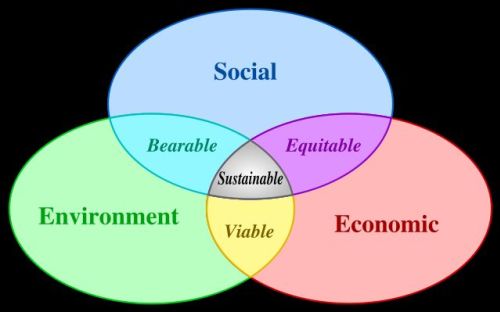
Sustainable development is a pattern of resource use that aims to meet human needs while preserving the environment so that these needs can be met not only in the present, but in the indefinite future.
In other words, development that meets the needs of current generation without compromising the needs of future generations is termed as sustainable development (as defined by the Brundtland Commission). Thus, when development is viewed in terms of “quality of life” and not mere “numbers”, the complementarity between environment and development comes to the fore.
To refute the notion that environment degradation is a necessary condition for growth and development, I suggest two propositions, which assert that environment and development can, and should exist simultaneously.
Firstly, development can help conserve environment. Thus, both growth and environment conservation can be achieved together.
Constructive intervention can help enhance the quality of environment; and development facilitates constructive intervention. Thus, development can not be provided as Read the rest of this entry »