Archive for July, 2009

Spend One Day As an ‘Environment Friendly Person’

Editor’s Note: Sampa Kundu has been working in the development sector for the past few years and after having finished her M.Phil from the University of Calcutta, has just moved into Delhi and has already begun exploring the city.

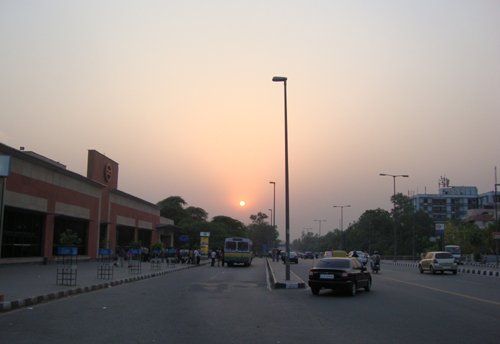
Sunset in Delhi University with the Delhi Metro in the vicinity

After the sunset, its time to green the sunrise, the very next day!

We all agree that a clean and safe environment is our first priority and requires immediate attention. But do we really bother about this issue? We all love to give advice and suggestions. We also love to make comments and criticize others and do not take into account our own faults.

This is common and general human nature. So don’t feel bad and don’t put pressure on yourself by thinking “Yes, I did this wrong thing and I polluted my own environment…I threw up a plastic bag on the road, I smoked in public place…’ and so on. 80% of the people cause harm to our environment.

The pollution of our environment is decades old and it is been being polluted from centuries. We have started facing the consequence of this today but for now, lets not recall the consequences. You are well aware of these and may have already been faced it yourself in real life.

This is an urgent plea to spend at least one day as an Environment Friendly Person:

For that one particular day:

  • Please avoid using Plastic Bags
  • Please plant a tree
  • Use public transportation and help reduce congestion and air pollution
  • Do not smoke while you are in a public place

Add some more to the list that would save our environment and follow it at least for one entire day. Then, after you are done, sit down and think about how it feels. And hey, there’s no stopping you from doing the same the very next day!

Comments (4)

From Tiger Hunters to Poachers: The Epic Journey of the Moghiyas of Ranthambore

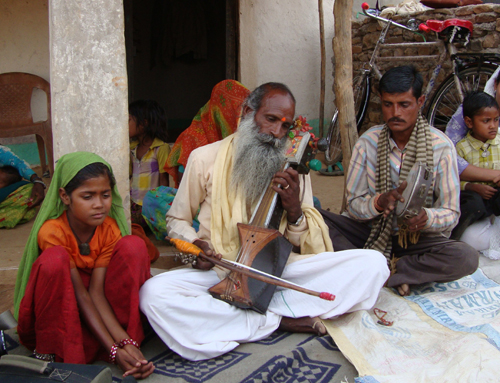
Moghiya Tribal outside the Ranthambore National Park
A Moghiya Tribal outside his house on the outskirts of the Ranthambore National Park, one of the first “poacher” to be rehabilitated by Tiger Watch

Continuing with the spirit of Save the Tiger campaign of Delhi Greens, I have an interesting story to share about the Moghiya Tribe that specialize in tiger hunting in Ranthambore, a Tiger reserve in Rajasthan.

This was narrated to me by a Moghiya tribal during a recent visit to Ranthambore as a tourist. Moghiyas are a sect among the Bavadias who claim to be loyal courtiers to the Kingdom of Udaipur. When the then King of Udaipur, Maharana Pratapsingh had lost his kingdom to Akbar, he had taken refuge in the forests. His loyal courtiers went with him and they pledged to never return till the King regained his rule. Until then, they chose to be rebels and sought shelter in the jungles. When the King could not regain his throne and died in exile, the loyal followers kept their word and did not return to the kingdom.

The Bhavadias got dispersed and their families got divided into separate clans over time, the main six clans can be identified even today. Some of them continued to live in forests. Others chose mobility, still others settled in villages. But none had lands or chose to get into settled agriculture.

Moghiyas, literally meaning tiger hunters, is one of this clan. Others include Kalvelias – snake charmers, Sasis – who  run brothels, Ghadia Lohars – black smiths, Phase Paradhis – hunters that lay traps for animals and birds. They chose not to be settled in one place. Not having land of their own and being soldiers known for valour – who had rebelled against Akbar, they continued to be ‘untamable’ by the Mughals and the British. Administratively it is difficult to control human groups that are not tied to lands.

Mobility was used by the Bavadias to continue to be more powerful and free spirited by choosing whatever occupation that suited them. The British branded them as ‘criminal tribes’ and tried to control them by tracking their movements. Whereever they went, their entry and exit to the villages had to be noted by the Kotwal of the village. They were usually the first suspect and were rounded up for any crime committed in the villages of their proximity, be it robbery, dacoity or murder.

What is interesting is that tiger hunting has been a sport and a sign of valour all through the ages. Historically the Aravallis and Vindhyas formed a continuous forest cover where the tigers could move freely and were plentiful. Hence the tiger hunts. Hunting as a leisure activity is still enjoyed by the elites today, albeit clandestinely. The hunting lodges and palaces still display Tigers mounted as Trophies and pictures of hunt by every ruler and his entourage.

In these Royal hunts, typically the elite hunter fired the final shot that killed the Tiger/s, after the Tiger is trapped and made ‘safe’ for the hunt. So some one had to take the risk of driving the tiger into the arms of the hunter and that job was done by the Moghiyas such that over time, they specialized in taking these risks. Now that hunting this big cat is banned, they are called ‘poachers’ and punished for doing something they were not only patronized to but also made to master.

Comments (1)

Invite: Talk on Green Education, Green Jobs and Teaching Sustainability with Kapil Sibal

Education for Sustainability - in an Era of Climate Change

Quarter Million Green Jobs

The Nehru Memorial Museum & Library (NMML), Teen Murti Bhavan in collaboration with a series of organisations invites everyone interested in green education, green jobs, and sustainable development to a talk by:

Mr. Kapil Sibal, Union Minister for Ministry of HRD, Ministry of Science & Tech and Ministry of Earth Sciences.

The talk will be followed by a short interactive session.

Date: July 29, 2009
Time: 6.30 PM to 7.30 PM
Venue: Main auditorium, Teen Murti House, Nehru Memorial Museum & Library

For more information, and to RSVP contact:

Vidya Subramanian
vidya@delhigreens.org

Comments (2)

Invite: Save Tiger, Save Humanity Rally in Teen Murti Bhavan

Even as there is no reliable estimate on the number of tigers that walk the jungles of India, and no agreement even on how to carry out the census – the tiger population in the country is on the expressway to extinction.

Tigers and the large number of ecosystem services they provide are being lost at an unprecedented rate. This has put the future of our generation and the generations to come, under grave danger.

The tiger is facing threats from poaching, habitat destruction owing to urbanisation, climate change and a mismanagement that has plagued the country ever since. Unfortunately, the efforts being made to help the tiger fight for survival (his and ours) are but a drop in the ocean.

Thus, Delhi Greens, and a series of organisations have come together and have called for a Rally for saving the tiger, and the right of future generations to survive and prosper.

Rally: Save Tiger, Save Humanity
Date: July 28th, 2009
Time: 09.00 am to 12.30 am
Venue: Teen Murti Bhavan (Opp. President of India’s House)

Inagural: Tiger Consultation Workshop
By Dr. Karan Singh, Member of Parliament
Time: 09.30 am to 10.30 am

Download Invitation Card For the Inaugural of the Tiger Consultation Workshop

——————————————————

Bill McKibben28th July, 2009: 06.00 pm

Hear about Climate Change from the man who told it first to the world: Founder of 350.org and a profilic author, Bill McKibben will give an inspiring talk on all the climate action taking place and all that needs to be done. He will be introduced by Bittu Sahgal, Editor, Sanctuary Magazine.

With the tiger numbers going down every day, this is our very last change to save the tiger, our future and the future of generations to come. It is on us now to secure our own future.

——————————————————

Invite: Education for Sustainability29th July, 2009, 6.30 pm: Education for Sustainability – in an era of Climate Change

A panel discussion with Union Minister for Ministry of Human Resource Development, Ministry of Science and Technology and Ministry of Earth Sciences Mr. Kapil Sibal and teachers and principals of schools and colleges.

——————————————————
We look forward to seeing all of you on the Rally Day on the 28th of July, 2009.

Hoping for a tigerful future!

Save Tiger, Save Humanity
Campaigns Team
Delhi Greens
www.delhigreens.org
RSVP: 9899472335 (Vidya)

Comments

Light A Candle for the Kondhs And Niyamgiri

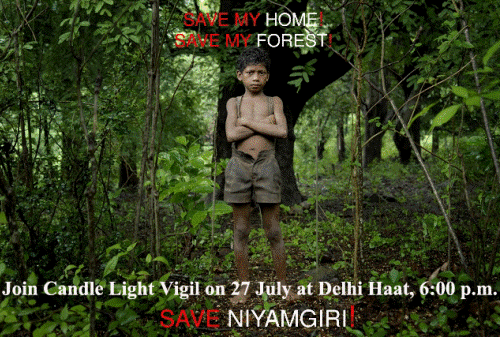
Save Kondhs, Save Niyamgiri

Orissa‘s Niyamgiri mountains are going to be mined for bauxite and the Kondh tribal community who have been living in these forests for generations in a sustainable manner will be dislocated. A pristine forest will be bulldozed to ground and with it humanity will lose a mountain that is a treasure of biodiversity and our collective ecological future in these times of climate change.

As a show of solidarity and to appeal to the consciousness of the policymakers, five tribal Kondhs and people of Delhi will join hands for a candle light vigil gathering and staging of shows on Monday, 27th of July at Dilli Haat (opp INA market).

Date: Monday, 27th July, 2009
Time: 6.00 pm
Venue: Dilli Haat

A Kondh representative will be in London on the same day to appeal to the shareholders of the campany to stop this from happening.  

This could be our last chance to save Niyamgiri and the future of Kondhs. And remember with the forests and streams gone, our future and theirs is going to be impacted together.

Comments

Top Five Reasons Why You Must Act to Save the Tiger

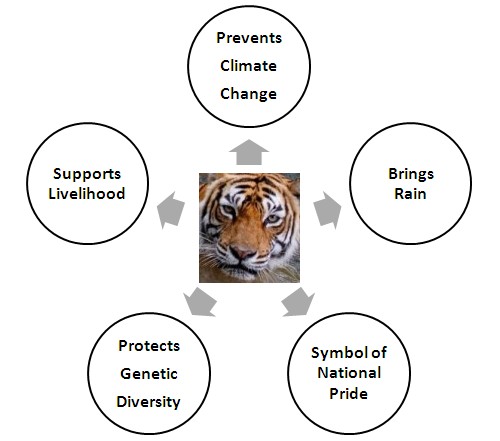
Why we must save the tiger

1. Tiger Supports Livelihood

Tourism is the world’s biggest industry. On the ecotour front, the tiger is a star attraction for not just the Indian tourists but also for the people coming from other countries. There are foriegners who come to India only to have a glimpse of the tiger and then there are others who return more than once for another such opportunity.

The look in the eyes of a canter that has just come out of a National Park after sighting a tiger is very different from the look and feel of a canter that could not sight any. This eventually impacts the tourist influx thus impacting everyone from the tour companies to the local tour guides. A healthy tiger population thus supports livelihoods as well.

2. Tiger Protects Genetic Diversity

Tiger is an umbrella species. It’s conservation automatically ensures the conversation of a large number of flora and fauna and entire ecosystems. Thus, a properly planned tiger conservation programme is actually a programme to protect and save large number of species.

However, a dwindeling tiger population and news of declining number of tigers only implies an immediate threat to what is remaining of our natural ecosystems. A healthy tiger population thus also protects all that remains of our natural ecosystems.

3. Tiger brings Rain

A tiger is a both a guardian and an indicator of a healthy forests. A healthy forests. Few understand that a live bird or insect is far more important to the economy than a dead one. A live tiger brings rain – a dead one brings nothing but devastation.

4. Tigers Prevent Climate Change

A healthy tiger population lives in large forests – which are nothing but the natural sinks of Carbon. The more tigers we can save, the more healthier reserves we have, larger is our national carbon sink. A tiger should therefore be entitled to carbon credits in the form of protection.

And last, but never the least…

5. Tiger is a symbol of our National Pride

This is what India.gov.in has to say about our National Animal:

The magnificent tiger, Panthera tigris is a striped animal. It has a thick yellow coat of fur with dark stripes. The combination of grace, strength, agility and enormous power has earned the tiger its pride of place as the national animal of India. Out of eight races of the species known, the Indian race, the Royal Bengal Tiger, is found throughout the country except in the north-western region and also in the neighbouring countries, Nepal, Bhutan and Bangladesh.


With inputs from Dr. Faiyaz A. Khudsar (Yamuna Biodiversity Park)

Comments (18)

Protecting from the unknown

The recent total solar eclipse episode is a once in a life time opportunity for any living being on this Planet. The next one is 105 years into the future. The entire audio visual media attention was on it. Every channel covered it in two very distinct ways. Each channel had atleast one scientist covering it and giving comments on the eclipse, how it occurs and its rarity. Along with this there would be images of hundreds of thousands of people who had gathered on the river side of Allahabad and Gaya. These are religious places with people taking the ‘holy dip’ in the river Ganga after the event.

The basic questions that were posed by the event were the same for which both the systems of knowledge tried to provide answers using their systems of beliefs. Namely: Is this event unique or rare? Is the event bad for human beings? Do we need to take precautions to protect ourselves from the event? Is there a causal explanation for what you have seen in the sky? Can humans be protected from its dangers?

The scientific community explained the uniqueness of the event scientifically by attributing an angle at which the moon revolves round the earth. It explained that it is bad to the naked eyes and hence one needs to take precaution to protect oneselve from the viewing of the event. Thus it provided a causal explanation that can be replicated in lab conditions. Humans can be protected by wearing special glasses before looking at it.

The religious community also had a unique explanation for the event that was predicted by Aaryabhatta over 100 years ago. It explained that the event is bad for the human body. Within the framework of Rahu and Ketu it also provided a causal explanation for the event. Humans can be protected by cleansing in holy waters, donation and discarding of the food cooked before the event.

Thus there are two separate forms of knowledge one propagated by scientific understanding and another propagated by religion. Each posing exactly the same questions and coming with very different answers and proposing completely different solutions. It is Mary Douglas a symbolic anthropologist who has proposed an analytical look into how systems behave in relation to purity and danger without getting into which is true or false. Any form of Systemic inclusion and exclusion, can be translated into the anthropological question of “purity and danger”. Thus every system of belief will classify irregular, rare, esoteric, as dangerous and hence impure and therefore needing cleansing rituals.

What you choose to believe is up to you. Will it protect /prepare you better from the unknown? It is anybody’s guess.

Comments

Brinjal Festival Showcases Diversity of Veggie in India

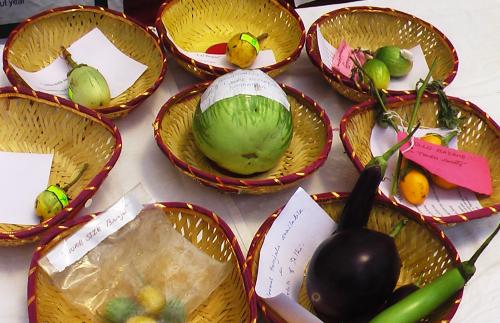
Brinjal Diversity

The I AM NO LAB RAT campaign underway in Delhi–to create consumer awareness on the adverse effects of Genetically Modified (GM) Brinjals–organised a colourful and unique ‘BRINJAL’ FESTIVAL in Dilli Haat yesterday. The festival was aimed at catching the Delhiites attention on this humble vegetable’s diversity being jeopardised and its socio-cultural importance discounted in government policies. 

The novel event had more than thirty different varieties of Brinjal from different states on display. The brinjals on display included Mattu gulla, Ram gulla, Lal begun, Billi-gundu badane, Gauri Bidanur, Sada desi gol begun, Jungly variety, Musuku Badane, Kanta begun, Md. Kuli, Sada Makra, Banamala, Garia etc.

The Indian diversity in brinjals is reflected in different colours of brinjals (not just the purple ones commonly seen but yellow, white and even red brinjals), in shape (long, round, bulbuous etc.), in size, in the plant quality (spiny, hardy, short etc.) etc. The flavour and taste of the different varities of brinjals is also different.

This rich diversity will be potentially jeopardized if Bt Brinjal is approved in the country as the first GM food crop. Most importantly for the Delhi belly, the festival also displayed a diversity of brinjal dishes from across the country.

Previously on Delhi Greens:

Comments (4)

Tehni Ropan: Some Hope for the Future (Generation)

Tehni Ropan

टहनी रोपण

पिछले दिनों के  सुखद मानसून और तेज आंधी के कारण टूटी टहनी को यह तीनो बच्चे बडे लगन के साथ दुबारा रोपने की कोशिश कर रहे हैं.

लेकिन इन मासूमो को क्या पता की यह आंधी से गिरी एक डाल हे लाखो के तादाद में लोग आस पास पेड़ काट कर विनाश कर रहे है. चलिये नन्हों ने मरते पर्यावरण के प्रति कुछ सकारात्मक सोच तो रखी.

Sent by Shri Rakesh Khatri of Nature Foundation India

Previously on Delhi Greens:

Comments (2)

International Training on Micro Hydro Power Units in Ladakh & Kargil

LEDGThe Ladakh Ecological Development Group (LEDeG) in collaboration with Bremen Overseas Research & Development Association (BORDA), Germany has been promoting environmental friendly Decentralised Renewable Energy Systems (DERES) for the past 20 years in the Western Himalayas. So far 72 Community-based Micro Hydro Power Units (CMHPU) have been installed by LEDeG in extreme and isolated mountainous regions.
 
LEDeG with its partners BORDA and the Consortium for DEWATS Dissemination Society, India and in collaboration with the University of Applied Sciences Northwestern (FNHW) Switzerland, is organising a two weeks training programme titled ‘International On-Site Training Programme on Community-Based Micro Hydro Power Units’
 
The training programme aims to impart basic skill required for planning; implementing and managing community based Micro Hydro Power Projects. The training is scheduled from 21st September to 2nd October, 2009 in Leh and Kargil districts of Ladakh.
 
The participants will have an opportunity to gain first hand exposure and practical skills while implementing a 30 KW community hydro power project at Bartoo Village of Ladakh region. The training team will comprise experts from different national and international reputed organisations representing a good balance between academics and practitioners. On the successful completion of the training course, participants will receive a certificate from the University of Applied Sciences Northwestern (FNHW), Switzerland.

The training program is subsidised and full scholarships is available for 3 selected participants.

For further information, please contact:

Stanzin Tsephel
Executive Coordinator

Consortium for DEWATS Dissemination Society
#621, 5th Main Road,
OMBR Layout,
Banaswadi Post,
Bangalore 560 043
 
Tel Fax:  +91-080-25452805  / 25452804
Airtel: 080-41614221
E-mail: bangalore@cddindia.org

Comments

Click for New Delhi, India Forecast