

The Air I Breathe in Twenty First Century
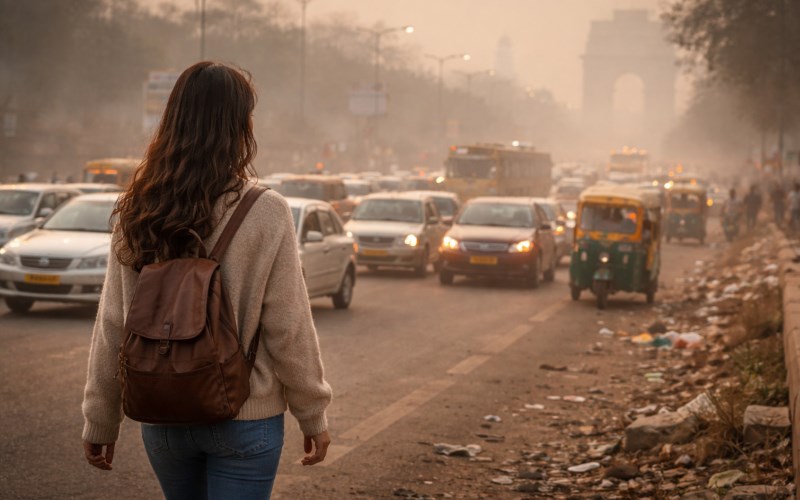
It was the month of December, bringing Delhi’s notoriously harsh winter conditions. December can become extremely cold, as much as it heats up in mid-summer. My parents had sent some Christmas treats via my cousin who was travelling through Delhi. I had to pick them up from a Metro station. It was already 9 pm when I returned after gathering my things. As I walked back to my place, I could smell the thick polluted air with every breath, making it difficult to even open my eyes.
Looking around, I saw people going about their business at brisk pace, yet I felt dejected and less privileged to be in such an atmosphere. It’s disheartening how normal this has become in our day to day lives. Every year at this time of the season, hundreds gather at Jantar Mantar to protest against the administration’s irresponsible handling of air pollution. It has almost become a ritual, a sad testament to the neglect of this pressing issue.
Sitting alone in my room, I pondered over the decline in Delhi’s air quality that I have observed since last five years of living here. Delhi is one of India’s ancient cities; it has been home to many great kings, emperors, poets and courtiers who have all praised its beauty. I couldn’t shake the feeling that the city does not deserve what is going through right now. This realization sparked my research into the causes of Delhi’s worsening air pollution.
I discovered that the first major Delhi air pollution crisis intensified in 2016. The year 2016-2017 marked the great smog of Delhi, with PM2.5 levels soaring above 750–999. When people learned about PM2.5, they were deeply concerned about the air they breathed and demanded ordinance to curtail this menace. PM2.5 is a fine particulate matter that serves as a key indicator of pollution. Studies have shown that it is primarily caused by vehicular emissions, stubble burning, industrial activity and construction dust.
Delhi’s pollution worsens during winter, beginning around Diwali in November and continuing until January post harvesting season. The impact of seasonal winds exacerbates the problem. Winter conditions in northern India trap pollutants, forming into smog. Cold and dry continental winds further degrade air quality. Therefore, the cause of Delhi’s air pollution is both, seasonal and continuous.
There are several options available to curb this air pollution. Construction can be slowed, private vehicle usage can be minimized, corporate timings could be adjusted, stubble burning can be stopped and production of organic fertilizers from crop stubble must be encouraged. Delhi’s air quality has only worsened since 2016, except during the brief period of the pandemic. The Government must take legal action to protect the city and its inhabitants. Instead, we often see the Government and the Supreme Court working in varied directions.
The Supreme Court’s November 2025 observation on Aravalli hills is caught much attention. It proposed that only hills with an elevation of 100 metres above ground would qualify as Aravalli hills. This decision sparked outrage among citizens and environmentalists; Aravalli hills are ancient mountains, and this diminishes their plain importance. According to one estimate, 90% of the Aravalli hill range may not meet the new criteria, potentially allowing for expansion of concrete buildings, industries, factories and even mining. The consequences could be severe, with significant ecological damage and even has implications for Delhi’s air pollution.
After so many years of living in Delhi’s hazardous environment, what truly pains me is how normal it has become. Except for a few citizens and environmentalists, more than half of the population has stopped bothering; even the most basic safety protocols like wearing a mask in polluted air is ignored. The privileged have installed air purifiers and stay indoors, while the less privileged are left to rely on survival of the fittest.
This is the air I breathe in India’s capital city, having had good education and earning my own pay check, yet somewhere deep down, I am beginning to resent it. Is this why I went to college? Is this the life I wanted to live when I was a little girl? What if it’s too late for me? It shouldn’t be too late for the future generation. They must know what breathing feels like. They must experience the pure taste of air, not the sourness of tartness or the burning dust in their eyes. They shouldn’t have to breathe through masks. They should be able to speak and laugh freely as they bump into friends & colleagues. In winter, they deserve to take in the cool fog in their mouths. When they take a deep, long breath on winter mornings, they should feel the chill all over their bodies.
Because isn’t that what breathing is, refreshing and not suffocating? We must leave an authentic city for future generations, not the artificially corrupted one we’re creating. We must ask ourselves what does a developed, advanced city truly mean when we destroy our lungs and have to hide behind masks? Why do we desire this fast-paced development which takes away from our life years? Perhaps it is time to redefine development altogether. After all, isn’t it all about concept and perception?

Great article