
Parenting in Delhi’s Smog: We Cannot Buy Our Children Clean Air One Purifier at a Time
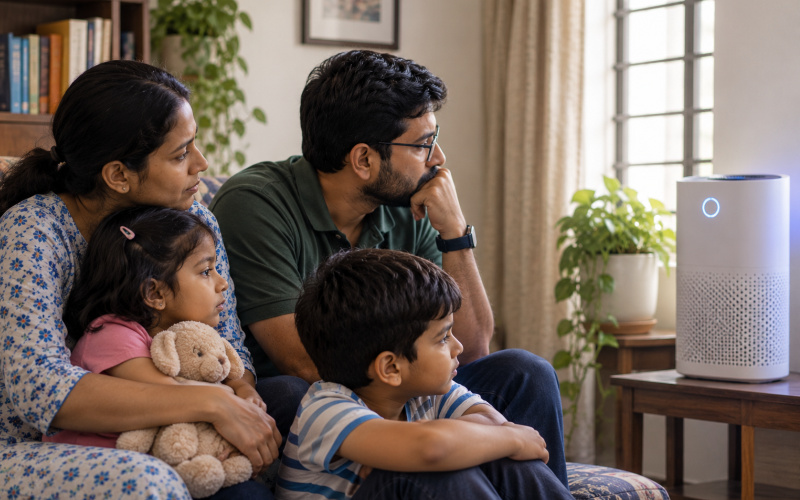
Every November, parenting in Delhi turns into a daily risk calculation. Is it safe to open the window? Should the school bus wait take place inside the gate? Is the mask on properly, or just hanging from one ear?
This month the questions came back on schedule. On 6 November 2026, the Commission for Air Quality Management (CAQM) invoked Stage III of its Graded Response Action Plan (GRAP) across Delhi-NCR, with the air quality index at 382, in the “very poor” band. The next day, as Outlook reported, the Directorate of Education moved classes up to Class 5 into hybrid mode. Children could attend school in person or online “wherever the facility is available”. That last phrase mattered more than anything else in the circular.
The following week, the air eased. Stage III was lifted, schools went back to regular classes even as Stage I and II curbs stayed in place. Many families will treat this as the end of the problem. It is only a pause. But the season is not over, and the same questions will return the next time the index climbs.
What the order looked like in homes
Behind the circular were millions of small household decisions. A hybrid option sounds like a choice, but it is only a choice for families who have something to choose with: a spare device, a steady internet connection, a quiet corner and an adult who can sit beside a seven-year-old during a video lesson. For many others, the decision was already made.
A parent who cleans houses, drives an auto or works at a construction site (work that Stage III itself restricts) cannot stay home. The child either goes to school or stays alone with a phone. In other homes, an older sibling stays back to mind a younger one, or a grandparent is left in charge of a screen they cannot operate. Either way, the “option” quietly moves the cost of bad air from the system to the household.
The World Health Organization calls air pollution “one of the greatest environmental risks to child health.” The reasons are physical: children breathe more rapidly than adults and so absorb more pollutants. They live closer to the ground, where some pollutants are most concentrated, and their lungs and brains are still developing. Parents do not need the fact sheet. They see it in the cough that lasts all of December and the inhaler that moves from the bathroom cabinet into the school bag.
The private market of protection
Faced with this, Delhi’s middle-class parents do what they have been trained to do: they buy. N95 masks in child sizes, a purifier for the bedroom, then one for the living room, apps that turn the morning into a colour-coded warning. The impulse is understandable. But the result is a city where a child’s lungs depend on household income. One child sleeps in filtered air. Another, a few streets away, breathes whatever comes in through the gaps in the door. Air was once the great equaliser; in Delhi it no longer is. And even the best-equipped home cannot filter the walk to the bus stop, the school corridor or the playground.
Then there is play time. CAQM has asked schools to move physical competitions out of November and December to safer months. That is sensible advice, but it takes away two months of running, cricket and sports days. Children who are already short of outdoor time lose what should be the most pleasant season to be outside, and they lose it year after year. Play is not a luxury. It is how young children build strength, friendships and the habit of moving, and no indoor activity period fully replaces it.
What parents should ask for
Parents are good at advocacy when it is about marks, fees and school buses. The same energy is needed for clean air. Three requests made by parents would make a real difference. First, protect children’s spaces, not just the children in isolation. Classrooms, where small children spend six hours a day, should come before offices when it comes to clean air. This means well-fitted windows, basic filtration and air-quality monitors in government and private schools, funded as permanent infrastructure, not emergency purchases.
Second, make “hybrid” equal for all. If online classes are offered, schools must lend devices and data to the families who need them and keep in-person classrooms open and safe for children whose parents cannot stay home. Third, count the cost to children. Every GRAP stage should come with simple public data: how many school days went hybrid, how many children missed lessons, how many sports days were cancelled. What gets counted gets fixed.
None of this needs a new committee. In government schools, School Management Committees, where parents hold three-quarters of the seats under the Right to Education Act, already exist for exactly this kind of conversation. In private schools, parent–teacher associations can put these asks on the agenda now, before the index climbs again.
Parenting has always meant protecting children from what they cannot see. In Delhi, for two months a year, this includes the air itself. No parent can buy their way out of a shared sky. The answer lies in what we demand together, from schools, from city authorities and from the people who regulate the burning, the traffic and the dust.