
World Landslide Forum Opens in India for the First Time
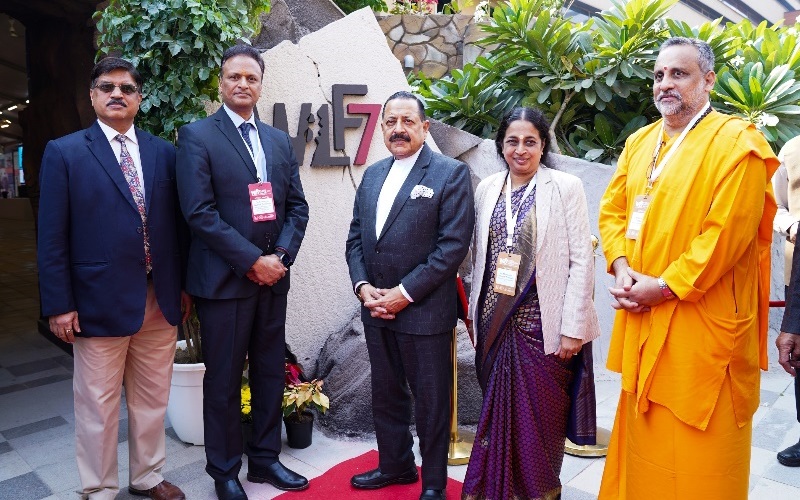
The Seventh World Landslide Forum began in Faridabad with a call to turn landslide science into timely action on the ground. Union Minister Dr. Jitendra Singh addressed the inaugural session, highlighting India’s growing focus on landslide prevention, forecasting, early-warning systems and the use of AI and geospatial technologies for disaster risk reduction.
The Seventh World Landslide Forum (WLF7) opened on Monday at Amrita Vishwa Vidyapeetham’s Faridabad campus, the first time the international gathering has been held in India and South Asia. The Forum brings together researchers, engineers, policymakers and disaster-management practitioners to examine how landslide science can inform decisions on infrastructure, land use and early warning. As per the Organising Committee, the Forum they received more than 700 papers and abstracts from 75 countries.
Union Minister of State (Independent Charge) for Science & Technology and Earth Sciences Dr. Jitendra Singh delivered the inaugural address. He said India is changing its approach to landslide risk, “from responding after a disaster to investing in prevention, forecasting and preparedness.”
He noted that the country’s varied terrain, from the Himalayas and the Northeast to the Western Ghats, makes sustained research and coordination especially important. According to the Minister, India is expanding landslide susceptibility mapping and forecasting, building stronger databases, and supporting the use of geo-spatial technologies, satellite observations, sensors and AI to improve risk assessment.
“Technology and scientific research must ultimately support timely action on the ground,” Singh said. He added that this requires continuous monitoring, close cooperation among institutions and last-mile warnings that communities can trust and act upon. He described the Forum as a platform for scientists, policymakers and governments to share experience and strengthen this collective effort.
Dr. Maneesha Vinodini Ramesh, Forum Chair and Pro Vice-Chancellor of Amrita Vishwa Vidyapeetham, said landslide risk reduction calls for “collaboration, care and a shared commitment to the communities most at risk.” She said she hoped WLF7 would strengthen connections among scientists, institutions, governments and communities, and help ensure that knowledge reaches those who need it.
Prof. Željko Arbanas, President of the International Consortium on Landslides (ICL), also welcomed the delegates. Indian officials on the opening-day programme included Dr. Srinivasa Kumar Tummala, Secretary, Ministry of Earth Sciences; Dr. Krishna S. Vatsa, Member and Head of Department, National Disaster Management Authority; and Shri Dinesh Vitthalrao Ganvir, Director General, Geological Survey of India. International participants include, among others, Dr. Soichiro Yasukawa, Chief of UNESCO’s Disaster Risk Reduction Unit; Prof. Kyoji Sassa, Secretary-General, Kyoto Landslide Commitment 2020; Prof. Matjaž Mikoš, Chair of the Global Promotion Committee for the International Programme on Landslides and the Kyoto Landslide Commitment; and Prof. Irasema Alcántara-Ayala, President-Elect of the ICL
A proposed Faridabad Declaration was presented as part of the Forum for consideration following a high-level review of the Kyoto Landslide Commitment 2020. It is intended to set priorities for international cooperation on landslide risk reduction and to help translate scientific findings into decisions on where to build, how to protect infrastructure and how to prepare communities for emergencies.
WLF7 is hosted by Amrita Vishwa Vidyapeetham under the aegis of the ICL, in collaboration with UNESCO and other international partners. It runs through 27 November under the theme “Landslide Science and Practice for Safe and Resilient Communities.”