
Assam Floods: We Need to Think Beyond Embankments
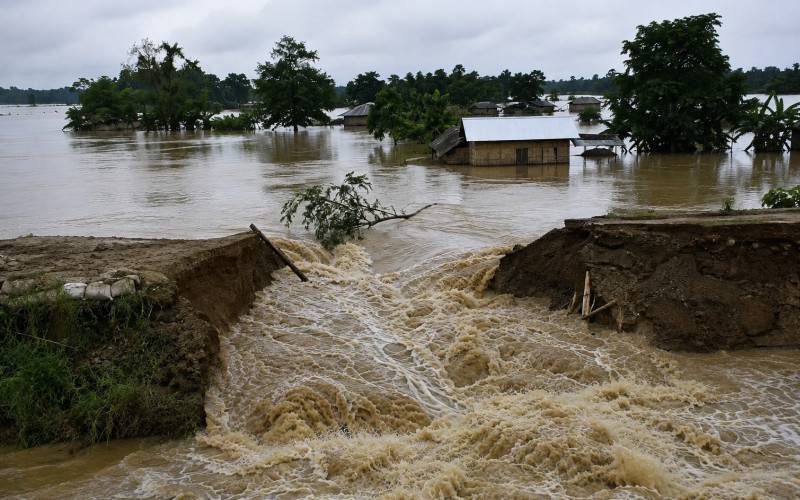
Assam is once again standing face to face with the painful reality of floods. Like clockwork, the arrival of monsoon brings a cruel, familiar disaster to Assam. Every year, floodwaters enter homes, destroy crops, disrupt education and turn the lives of thousands of families upside down. Year after year, thousands of families watch their homes wash away, crops rot in inundated fields, roads dissolve into mud and daily life grinds to a sudden halt.
Yet behind these statistics are stories of loss, courage, and survival — children losing their books, farmers losing their harvests, and families leaving everything behind. The flood is not merely a natural disaster; it has become a recurring struggle for Assam’s people. As the floodwaters slowly recede, the same despairing question echoes across every affected village and town: Will Assam ever find a permanent solution to this nightmare?
The truth is, there are no easy answers.
Whenever floods hit, the default demand is almost always the same: build more and stronger embankments. While embankments certainly offer crucial local protection to countless communities, relying on them as a silver bullet is a dangerous mistake. Embankments cannot stop floods. In fact, during extreme high-water events, when an embankment breaches, the sudden rush of water often causes far greater devastation than a gradual rise in river levels. A river as wild, dynamic, and massive as the Brahmaputra simply refuses to be chained by walls of earth and concrete.
To understand Assam’s plight, one must look beyond its political boundaries. A massive portion of the water that submerges Assam originates outside the state. The Brahmaputra begins its journey high in Tibet before crashing through Arunachal Pradesh and descending into Assam’s plains. Dozens of major tributaries pour in from Meghalaya, Nagaland and neighbouring Bhutan. When torrential rains strike these upper catchment areas, an overwhelming surge of water cascades downstream directly into Assam.
Climate change has made this fragile balance far more volatile. Rising temperatures across the Himalayan belt are accelerating glacier melt and disrupting weather patterns. Monsoon rains were always heavy, but today we face frequent, unpredictable cloudbursts that unleash catastrophic flash floods with virtually zero warning.
Compounding the crisis is widespread deforestation across the region. Forests act as natural sponges, absorbing heavy rainfall and holding topsoil in place. Strip away that forest cover, and rainwater rushes instantly into the river channels, dragging millions of tonnes of sand and silt along with it. This massive silt load settles at the bottom of the Brahmaputra and its tributaries, raising the riverbeds every year. As the rivers grow shallower, their capacity to carry water plummets, causing them to overflow at the slightest spell of rain while aggressively tearing away at their banks. In hilly areas, deforestation triggers severe landslides that can temporarily dam rivers; when those fragile barriers collapse, a terrifying wall of water surges downstream.
Yet, Assam cannot point fingers entirely at its neighbours or nature. We have systematically dismantled our own natural defences. We have filled in vital urban wetlands, built over natural drainage channels and allowed rampant construction on floodplains. Look at Guwahati: poor urban planning and choked drains result in severe artificial flooding after a short spell of rain, completely independent of the overflowing Brahmaputra.
What about large dams and hydroelectric projects? Some argue they hold the key to flood control. While scientifically managed reservoirs can absorb peak flood waters to an extent, they are not a panacea. More importantly, because these mega-projects sit outside Assam, the state has no direct say in their operation, just as it has no jurisdiction over deforestation or illegal mining in neighbouring states and countries.
All of this points to one undeniable reality: Assam cannot solve this crisis alone.
Effective flood management demands genuine regional cooperation. It requires seamless coordination between the Central Government, the north-eastern states and Bhutan, alongside real-time sharing of rainfall and hydrological data from upstream regions.
Instead of relying strictly on heavy civil engineering, we must pivot toward scientific river basin management: protecting forest cover, restoring degraded wetlands, developing accurate early-warning systems and enforcing climate-resilient urban planning.
Floods are an intrinsic part of Brahmaputra’s ecology. In moderation, they deposit rich, fertile silt across agricultural fields and sustain fragile wetland ecosystems and wildlife. The goal can never be to eliminate floods entirely, that is an impossible fight against nature. The real goal must be to minimize the loss of human lives, homes and livelihoods.
At the bottom of it is the realization we must accept that Assam’s floods are not merely a local issue; they are the cumulative result of natural forces and human intervention across an entire river basin. If we want a safer, resilient future, we must look beyond state lines. Only through sound science, environmental stewardship and true regional solidarity can we protect the millions whose lives hang in the balance every monsoon.