

Common Palm Civet at JNU
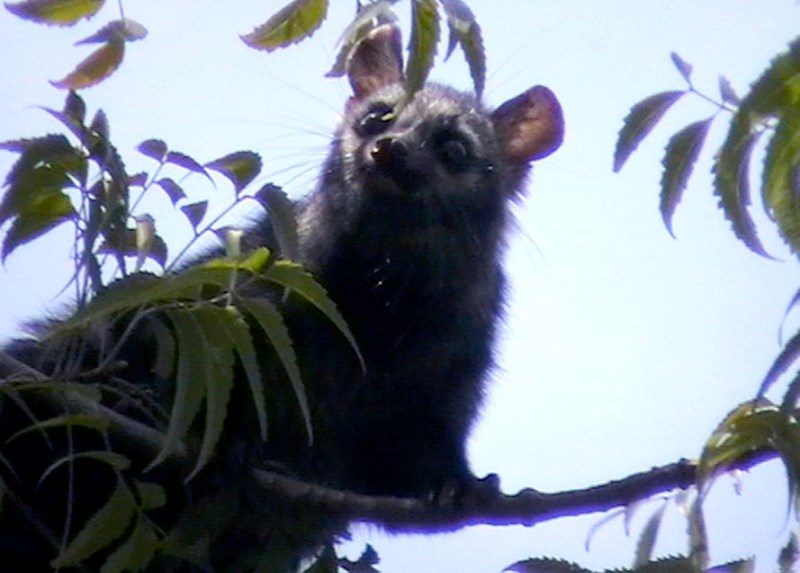
For all the Delhiites who havn’t really seen any real ‘wildlife’ in the city, you’ve got to check this out. Dr. Surya Prakash of JNU spotted a COMMON PALM CIVET (Paradoxurus hermaphroditus Schreber 1778 ) near JNU’s SBI ATM!
He was also able to capture the animal on camera as under:
The Common Palm Civet is a rare animal which is listed in Schedule II part II of the Indian Wildlife (Protection) Act, 1972. It is a nocturnal and omnivorous animal that prefers to feed on fruits.
Dr. Surya Prakash can be contacted at the following email address: surya@mail.jnu.ac.in


Everyone loves what you guys are up too. This type of clever work and coverage!
Keep up the superb works guys I’ve included you guys to our blogroll.
Your style is really unique compared to other folks I’ve read stuff from. I appreciate you for posting when you have the opportunity, Guess I’ll
just bookmark this site.
Nice Site, Keep up the beneficial work. thnx.
hello there and thank you for your info – I’ve certainly picked up anything new from right here. I did however expertise several technical issues using this site, since I experienced to reload the website lots of times previous to I could get it to load properly. I had been wondering if your hosting is OK? Not that I am complaining, but sluggish loading instances times will very frequently affect your placement in google and could damage your high-quality score if ads and marketing with Adwords. Well I’m
adding this RSS to my e-mail and can look out for much more of your respective interesting content.
Ensure that you update this again soon.
May I simply say what a relief to discover somebody that genuinely understands what they’re discussing on the web. You certainly realize how to bring an issue to light and make it important. A lot more people must look at this and understand this side of the story. I can’t believe you aren’t more popular given that you most certainly have the gift.
..hello Dr.Surya Prakash..
..i am a student of JNU and i love the campus out here..so full of wilderness….i have seen nilgais,wild rabbits,snakes,scorpions and porcupines..but never a palm civet…
..thanks for sharing this information..
I am actually thankful to the owner of this web page who has shared this great article at here.
Hey there just wanted to give you a quick heads up.
The text in your article seem to be running off the screen in Internet explorer.
I’m not sure if this is a formatting issue or something to do with web browser compatibility but I thought I’d post to let
you know. The layout look great though! Hope you get the problem resolved soon.
Kudos
Does your blog have a contact page? I’m having trouble locating it but, I’d like to send you an e-mail. I’ve got some creative ideas for your blog you might be interested in hearing. Either way, great blog and I look forward to seeing it expand over time.
HI Everyone, I Am a regular jogger in jnu stadium and i have noticed wild rabbits, neel gaye (wilder beast), civets many a times…
I Thnk dere might also be some leopards around 🙂
Reporting another sighting: I got back home past midnight yesterday and was greeted by a ‘wild cat’ sitting on the steps leading to my house. It stayed for a bit and then ran away. I could not take any pictures. A Google search to identify what I thought was a ‘cat’ led me to this site and I realized it was a Civet. I live in Green Park adjoining Deer Park.
Seeing these rare animals is very interesting.
Its a message to everybody to preserve the nature.
i and few others have spotted a similar looking animal in south campus few days back , delhi university , near dhaula kuan
Excellent find!! i have never seen such a thing in Delhi…never on a tree top anywhere.
It’s heartening to see your work getting recognition. All the pain taken over the years finally gaining you your due. Wish you all the best in all your future endeavours.
Dear Dr. Suraya,
Congratulations, excellent job. Also spotted by me in one of the warden’s house, Periyar hostel.
The sighting of Palm Civet in JNU campus by Surya Prakash is just one of his recent accomplishments. An ardent Nature lover, he has recorded excellent pictures of wildlife in JNU campus.
Because the wild life animals and birds can not be easily sighted during the day, this is also testimony to how effectively and productively one can use the early mornings and evenings, without disruption of work! Congratulations! Keep up the good work.
Dear Sir,
Good to see your work getting recognition. Congratulations again.
Best wishes,
Sujith
Dear Surya Prakash,
Good job and thanks for sharing it with me. Keep it up.
Congratulations Sharmaji.
Looks like you are becoming a wild life scientist.
Hope everything is fine with you and your family. Here we are all fine.
Take care and keep in touch.
Regards
Valsala
Great find. Awesome.
Great! Thanks! I noticed the same animal once a few years back around the midnight on the east side road towards VC’s lodge.
Best luck and regards-
congrats and by the way-though late – the article in IE was also good
Great job!
Congrats!
Neelima
Dear S.P.
Nice photograph. It is good to know that you are going back to the topic of your own interest which fascinated you about 25 years back! I wish you all the best for your future endeavours …..
Bye.
Congratulations to Surya sir……….finally you achieved your goal….that was the ultimate goal of your life…………..my god wishes to you.
JNU is a place where we can see beauty, varieties, culture, and customs. Really good piece work and efforts, whole JNU family should come forward to protect and conserve the wild life…I feel proud that I am also a part of JNU.
It ‘s really a very good and wonderul picture of the rare animal. We are in a way yet to know about many new and unknown things. You are really an inspiring and ambitious to anyone around you. JNU campus with its wide range of flora and fauna has one more add in it.
Does the Common Palm Civet, have a long and furry tail? Unfortunately, we’re unable to see the tail.
Several years back, I had photographed a very similar looking dead animal on the Aruna Asaf Ali Marg. I showed it to some people at WWF and they told me it could be a Civet. Thanks for nearly confirming, that this was the same animal.
The most recent sighting I had of the Common Palm Civet was in Vasant Kunj, about 4 years back, when it was climbing some first floor resident’s canopy above the window at night.
Great work Dr. Prakash!
Regards,
Rahul Dewan
Congratulations to Surya Prakash, who has been reminding us of wild life around JNU’s 1000 acres green campus. Dr. Prakash amply defies the myth sometime propogated that JNu campus in losing its grip over wild life. I remember he has captured even rare birds breeding and so on.
Good work and we want to communicate that we do care.
Hi,
Very good and exciting sighting. This shows, so much we are yet to know what animals are living along with us in Delhi. This is mainly thanks to so much of open spaces with vegitation in and around Delhi.
I have sighted even Mongoose in Malaviya Nagar. They make a living in the parks. Isn’t that interesting.
Thanks for the posting.
I have taken around 50- 60 photos of this Wild Animal . Also when some one killed this animal in night by a car in Campus itself. Pleas be careful for animals also while driving.