Archive for September, 2009

Of Things We Don’t Know: Formal Notes from an ‘Informal’ Sector!

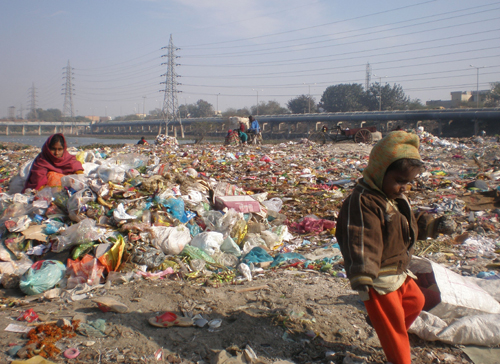
Ragpickers at Zero Pushta, Delhi

A trip to the Ranthambore Wildlife Sanctuary got me thinking. I realized that the jungle supports livelihoods of the tribal people who have essentially been hunters and gatherers by profession. They do not own the forests or even part of it, they only access it and use it to meet their every day needs of survival.

They go in the forests to collect food, fodder ,fuel and small timber. Just the way it is, without altering the habitat or without disrupting the resource base. They visit different places, trees, wines, shrubs in different seasons to collect berries-nuts-fruits-flowers-leaves and other products like honey or tree bark and roots. All that requires an intimate knowledge of the forest.

These resources are not ‘free’ – as it needs efforts and knowledge to get them, without having a calendar or a planner to make notes. This is passed on to others over time and generations without text books or computer records. The appreciation of nature comes from the experience of nature.

This made me think about ragpickers in the city–who are–in an anthropological sense ‘gatherers’ and may well be using the same strategy to survive in the city. They are beyond the monetized economy and they survive,  they know where to find food or money, at what time, at what places, including religious places and hotels.

All this requires efforts? Yes. Hard work and bargaining with others? Yes. planning and decision making? Yes. Weighing pros and cons for a visit to a particular part for gathering goodies? Yes. What it does not require is exchange of money as we know it. Their every day lives do not involve a need to exchange cash in return for services or for food or for fuel or for more substantive needs of housing or clothing or entertainment or possessing things.

But they visit the garbage dumps for collecting material that they can recycle like plastic, metal, paper, cloth, etc. that has some monetary value. Collect left over food from houses or restaurants or religious palaces for eating. What is left behind is rotting garbage–’waste’–that gets recycled in the natural order of things.

I am sure a more detailed inquiry into the life of scavengers living in cities will tell us about their efforts at planning, strategizing, exchange of information, goods, efforts, etc. It is an area we do not yet know … could it be possible that an entire knowledge base–a complex of decision makers and a group of people related to ‘Green City’ that may exist and we may not even be aware of their contribution, leave alone quantifying, measuring and acknowledging it?

Comments (4)

Chandrayaan Discovers Water on Moon…

Water Found on Moon, Earth Calling

“चाँद पर पानी मिल ही गया, अब शायद हमे भी मिल जायेगा.”

थोड़ा पानी चाँद से इनके लिये भी ला दो

Comments (1)

Green Consumer Day: Make the Right Choice!

Making the Right Choice - Green Consumer Day

On the occasion of Green Consumer Day, it is time to think and re-think of what we buy, how and the impact it has on us and on our common environment. Motivated by the universal need that has arisen, it is the day to carefully list down individual ways in which all of us can make a difference.

Some Green Buying Tips to Keep in Mind:

  • Walk or cycle to your marketplace
  • Find out where your food comes from. Read, Research, Investigate!
  • Buy local, always
  • When buying, make the intelligent choice keeping your ecological footprint in mind
  • Buy only when (and what) you really need to. The best way to be a green consumer is by not having to buy anything at all!
  • Reduce, Reuse and Recycle. And Freecycle!

Remember, the choices we make today have a long shelf life and an even longer half life! It not buying can stop the killing, buy responsibly can indeed take us into a sustainable future.

Image Modified from The Green Daily

Comments (1)

Announcing: UK Environment Film Fellowships 2010

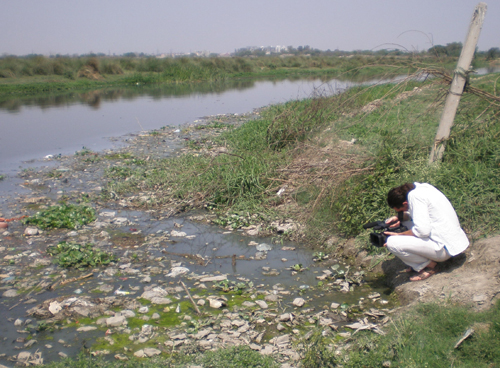
Filming the Yamuna in Delhi

The UK Environment Film Fellowships have been awarded every year since 2005 to Indian environmental filmmakers, to create 12 minute impactful documentaries. Till date, 20 filmmakers have been awarded with these fellowships.

Every year, a theme is decided and filmmakers are encouraged to submit proposals for films which depict originality in research work in terms of topical relevance to the theme. Filmmakers identify and team-up with subject experts/ professionals/ institutions and work closely with them during the making of the film to ensure a well-researched and high quality film.

The purpose of UKEFF is to build capacity and encourage the environment filmmakers’ community in India. The films made by these filmmakers are important communication tools that drive awareness and action among viewers on the impacts and possible solutions for safeguarding the environment in India.

Themes for the 2010 fellowships:

  1. Climate Change and Cities focuses on the various aspects of climate change and how it particularly affects cities in India
  2. Climate Change and Water evokes to highlight the issues around this important resource

A filmmaker can submit more than one proposal based on any or both themes.

Eligibility criteria:

  • work experience in filmmaking
  • originality in research work and topical relevance to theme area
  • capability to identify and build a team of subject expert/ professionals/ institutions to work closely
  • deliver a well researched and high quality short film

Closing date for entries: 2nd November 2009

For more details on the fellowships, application form, submission procedure and for watching the award winning films of the past, please visit UKEFF 2010 British Council’s Environment Film Fellowships or contact:

S Kumaran
Projects Executive
Projects Unit
British Council

737, Anna Salai
Chennai 600 002
Tel: 044 42050663

Comments

Inclusive Beauty

Something about beauty, which is perfection, always touches, moves and inspires people. Judging by the responses to the blog I seem to have done that. I truly appreciate you all, who make that extra effort to share with me how you feel. That is my inspiration to write every week. Thank you.

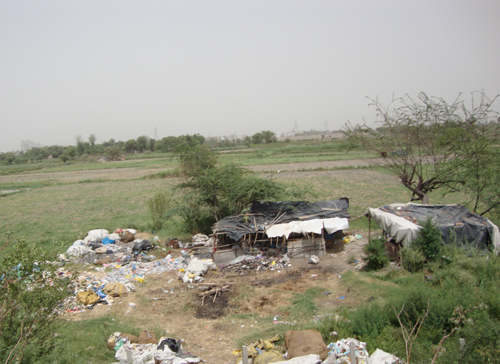
A Slum on Yamuna Floodplain

Continuing on the theme of beauty and perfection, in one of my recent works I realized that slums in mega cities–considered as blotch on the city landscape–are located in ecologically sensitive areas, sea coasts river floodplain, along ponds, forests etc. In Delhi too, they are located, to the best of my knowledge, in ecologically sensitive areas. These slums tend to be in river basins like Yamuna and Ganga, or hill slopes and foot hills of the ‘Ridge’ with minor forest lands etc.

These ecologically sensitive habitats got included within the ‘developed’ city as the city grew. Planning authorities expanded ‘urban’ boundaries to include them within city limits. Truth be told, ecologically sensitive areas are excluded in the Master Plan from future formal planning, growth and development of the city. The intention in declaring these areas beyond formal planning is to protect and conserve the fauna and flora, before the city growth destroys the natural habitat that once thrived here.

Also, when a city expands and prospers migration from rural areas increases. Very often these ecologically sensitive areas are ‘informally controlled’ and therefore cheap to occupy and be ‘encroached’ upon especially by first generation migrants. When there are distress migrations due to droughts or floods, families relocated to urban areas have no place to return to. They build their houses on these lands for there is a possibility of some livelihood, subsistence labour or even begging and access to drinking water.

The women in these first generation migrants are familiar with using natural resources from nature–free food, fodder, housing and fuel needs. Especially if they have young children and not a very regular source of income, women find this access to natural resources, a boon. Therefore natural resource degradation of the ecologically sensitive areas is inevitable.

Over time these relatively clean ecological spaces get polluted or degrades due to population pressure and economic and industrial growth of the city. This reduces any access, to clean environmental resources that these urban poor women and children may have enjoyed, in the past.

Comments

Thoughts On Perfection And the Making of a City

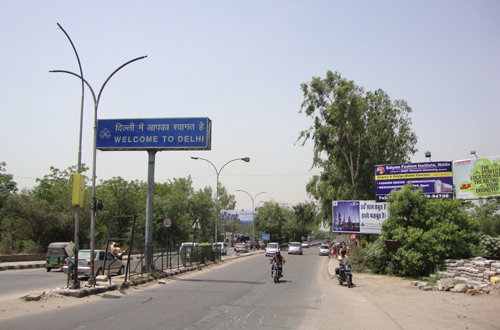
Welcome to Delhi

Recent rains in Delhi have brought the kadamba tree in full blossom. This tree is one of the trees depicted in the carvings of the Ajanta Caves. An apsara is shown holding on the branch of the kadamba tree in full blossom. As many of you may already know that an apsara is considered an ideal of beauty, a perfect woman. She is holding on to the perfect tree. The tree is perfect for its beauty. It always grows erect. The branches are perfectly parallel to the ground and grow in perfect cemetery around the stem. The smaller branches too grow symmetrically to the main branch and perfectly symmetrical to each other. The leaves that grow on these branches are perfectly symmetrical even the veins on the leaves are equidistant and parallel to each other. The tree thus casts a perfectly circular shadow on a warm sunny day.

Then it rained in Delhi. It was humid the clouds were still there, the conditions were just right, and then this tree flowered. The flowers grow under the belly of the leaves always at the end of the small branches and they all blossomed simultaneously, at once. The hypothalamus is a perfect sphere and mounted on these are tiny golden rays of flowers. When I stood under the tree and looked up, the flowers glowed like a million suns and the canopy was a perfect umbrella. Then, I truly understood, why this tree is considered to be the perfect tree, an ideal among trees…for its perfect symmetry and structural beauty. It was stunning.

Then the inevitable happened. Within 48 hours, the flowers wilted and fell to the ground and the new ones that replaced them were just that, replacement. This stunning beauty lasted for only two days. Does that mean that the tree is any less perfect? Or that the ‘ideal’ type of a tree should be abandoned or redefined?

 Should I then give up on perfection at all as it cannot be achieved or if I did achieve, it is short lived? Why bother to aspire to create and live in a perfect city of Delhi? Since it can never be achieved or if it did, it would never last?

The answer is what else is there? The image of a perfect city gives our lives a meaning, something to aspire for and keeps us in action. With out that we will have nothing to look forward to. We would be resigned and cynical. The ideal image of a powerful and perfect Delhi perhaps gives us hope and future to live into….

Comments (2)

Training: Particiapatory Planning & Decision Making Using GIS

Development Alternatives

TARA Livelihood Academy of Development Alternatives, a non-profit organisation established in 1983 creating large scale sustainable livelihoods is organising a Capacity Building Series (2008- 09) on Experiential field based training on Drinking Participatory Planning and Decision Making using – Geographical Information System (GIS).

Sustainable development is largely a replication of how people interact with the available natural resource base. Very often, environmental degradation is due to over population and poor socio-economic conditions. The need for proper monitoring and management has arisen to fulfill the targets of achieving sustainable development.

Geographic Information Systems (GIS) is an undeniable valuable tool for gathering and analyzing environmental information and helps in observing, measuring, mapping and monitoring of the Earths natural resources.

Objectives of the Training:

  • To make participants understand the basics of Geographic Information System (GIS) and how it can facilitate in planning and decision making
  • To acquaint them with tools, techniques and information that would be required to undertake GIS application in various thematic areas (NRM, Disaster Management, watershed development etc).
  • To share DA’s experiences in using GIS for various development projects

The course is specially designed for  professionals working in the development sector giving  general scope and exposure to  GIS and its applications in a modular structure with hands on experince on the latest software in  twenty hours.

COURSE CONTENTS

  • Geographic Information System (GIS): Concepts
  • Application of GIS
  • GIS Implementation (how to develop the GIS cell in your organisation)
  • Case Studies

Duration: 3 Days

Fee:

  • INR 9,500/- per participant for Indian Participants
  • 250 USD for Overseas Participants

Date: 7th to 9th October  2009

Venue: Vasant Kunj, New Delhi

Click here for the nomination form

For more information and to register, contact:

Bhavana Gadre
Telephone: 011-26132718
bgadre@devalt.org

Comments

Mera India: Bridge the Gap Contest

Agent of Change contest

Unnati Features and Women’s Features Services invite the youth of India to take the challenge, and be the change! Enter the Mera India, Bridge the Gap contest

By 2015, India has pledged to achieve the following eight Millennium Development Goals (MDGs):

  • Eradicate extreme poverty and hunger
  • Achieve universal primary education
  • Promote gender equality and women’s empowerment by eliminating gender disparity in schools
  • Reduce the child mortality rate
  • Reduce the maternal mortality rate
  • Combat HIV/AIDS, malaria and other diseases
  • Ensure environment sustainability
  • Develop global partnership for development

As an Indian, your role should be to assess the shortcomings and challenges that lie before us, and be ready with ideas and innovation on how our country can achieve the Millennium Development Goals (MDGs).

The Contest

How to Enter

  • You should be an Indian citizen between the ages of 18 to 35 years.
  • The first step is to register with the organisers at indiabridgethegap@gmail.com with your name and Email ID.
  • You must acquaint yourself with the Millennium Development Goals.
  • Then rank the following 10 constituents on a scale of 10 to 1, in their order of importance for the achievement of the MDGs. The category you feel is more important figures higher on the scale.
  1. Celebrities
  2. Corporate leaders
  3. Educationists
  4. Elected representatives
  5. Government officials
  6. Health personnel
  7. NGOs
  8. The Judiciary
  9. The Media
  10. The Youth
  • Tell us what you think are the most important things to be done towards achieving the MDGs. You may choose from the following formats to express yourself:
    • A 1000-word essay
    • Or a pictorial strip
    • Or a film not longer than five minutes using a mobile phone or digital camera.
  • Every contestant must enclose a birth certificate and a statement certifying that the work submitted is original.
  • Each contestant can send in only one entry. Entries from teams comprising not more than three persons would also be considered, provided that the oldest member in the team is not more than 35 years.
  • Entries should be sent in an envelope marked ‘Mera India, Bridge the Gap’ to Women’s Feature Service, G-69 Second Floor, Nizamuddin West, New Delhi –110013.
  • Entries can also be emailed to: indiabridgethegap@gmail.com, along with a scanned birth certificate and statement certifying that the work is original.

The Prizes

1st prize – Rs. 75,000 | 2nd prize – Rs. 50,000 | 3rd prize – Rs. 25,000

Each entry would be judged on its content, its innovative nature and the practicability of the ideas suggested. The jury will be a panel of independent persons well known in their respective fields. Prize winners will be invited to a special awards function in New Delhi and your ideas will be shared with policy makers, civil society leaders and people in various fields who can make a difference.

Last Date for receiving entries: October 5th, 2009

For more, click here | Source

Comments

Underpass & Flyovers: Blueprint for Delhi’s Destruction?

Delhi Shaken with Floods

A shaken Delhi

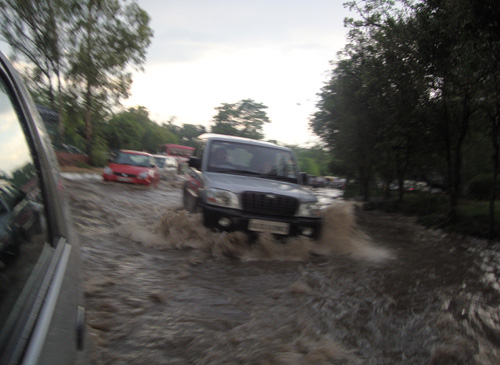
For a city where 98% of the total annual rainfall pours down in less than a month, planning can never be easy. When the latter is carried out hurriedly as if to meet a certain 2010 target, what can happen is what Delhi is witnessing today. A delayed monsoon that gave up to the changing climate met an infrastructure in the making of a ‘world class city’. Roads were flooded with water (and cars), parts of it went down, trees uprooted themselves, the Metro Rail stopped and the traffic came to a standstill. Urban mobility was yet again held ransom. Any by none other than the very forces of Mother Nature which only ask for a sustainable development in exchange.

The first of such downpours in this season, which took place during the evening hours of 27th of July, not just clogged the traffic, it also flooded Delhi and put the spaciously built Lodhi Colony under five feet of sewer water. The stretch from India Habitat Center to Kotla experienced a Mumbai that night and residents (some of whom were living here for the past 18 years) were shocked at something that had never before happened to their part of the city. The water entered the parked cars and stranded several including me in the flood. The rains stopped and so did the rising water level but most ground floor residents did not sleep that night.

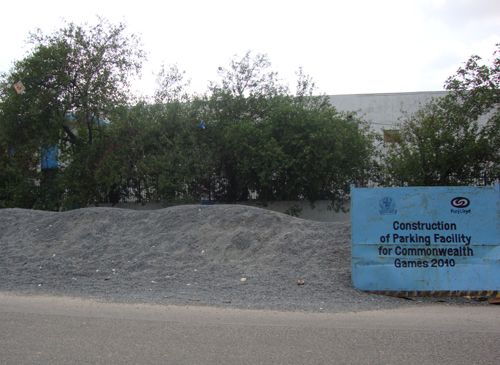
Apparently, the nullah adjacent to Lodhi Colony (that separates it from Kotla) is being closed and concertized to make parking space for the nearby Jawaharlal Nehru Stadium (for CWG 2010). The temporary stoppage of sewer water for the construction work could not hold the rains and stormed into Lodhi Colony. With the nullah gone and the sewer outfall into it closed, flood water had no place to go. A clear case of interfering with the natural drainage of the city, leading to a perfectly understood “man-made” disaster.

Read the rest of this entry »

Comments

Public Lecture: Rejuvenation of River Yamuna: A Blue Print for Action

Toxics Link’s Environment & Health Public Lecture Series

ToxicsLink Logo

River Yamuna today is one of the most polluted and threatened river system in the country. This is despite more than a decade long effort by the state to rejuvenate it under the Yamuna Action Plan (YAP) with results that do not inspire confidence in either the state’s understanding of the problems facing the river or the approach taken by it to mitigate the ills facing the river till date.

Yamuna Jiye Abhiyaan (YJA) – which is a research based campaign run by a consortium of a number of NGOs and individuals in the city – has studied the river for over two and a half years now, and have resultantly arrived at an understanding about the ills facing the river and possible solutions that would facilitate a rejuventaion of the river. This conference presentation is about the same.

Speakers:

  • Shri Manoj Misra – Convenor, Yamuna Jiye Abhiyaan
  • Shri Ramaswamy R Iyer – Former Secretary, Ministry of Water Resources, Government of India
  • Shri Himanshu Thakkar – Coordinator of the South Asia Network on Dams, Rivers and People

Moderator:

  • Shri Samar Singh – Senior Advisor and Director, NHD, INTACH

Date: 18 th September 2009, Friday
Time: 6:30 p.m.
Venue: Conference Room I, India International Centre, Lodhi Road, New Delhi

(In collaboration with India International Centre)

For further information, please contact:
Pragya Majumder – pragya@toxicslink.org
Tel: 24320711, 24328006
Email: info@toxicslink.org

Comments (1)

Click for New Delhi, India Forecast