October 29, 2009 at 10:34 pm
by Aastha Kukreti · Filed under Events
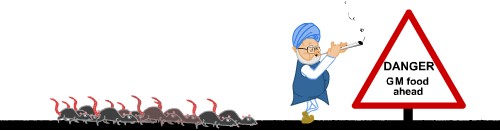
Are you (being planned to be used as) a Lab Rat?
The I Am No Lab Rat Campaign and a coalition of NGO’s and civil society groups invite you to a day-long orientation session on the impacts of introducing and cultivating Genetically Modified (GM) crops, that (will) eventually end up on your dining table.
The interactive session is being held on the “Intricacies of Genetic Engineering in Agriculture AND Scientific Evidence on the impacts of GMOs and will be led by Dr. Michael Antoniou, Reader in the Department of Medical & Molecular Genetics, King’s College, London.
Date: 2nd November, 2009 (Monday)
Time: 10.30 am to 3:30 pm
Venue: USO House (Near Katwaria Sarai Bus Stand), USO Road, Jeet Singh Marg, Delhi
Those interested to attend are requested to register themselves latest by 30th October, 2009 (Friday)
For further information and to register, contact:
Radha Kapuria
Mobile: 9818248459
Email: iamnolabratdelhi@gmail.com
Previously on Delhi Greens:
Permalink
October 28, 2009 at 6:16 pm
by Gialome · Filed under Articles

To recap, water available per person has been decreasing since 1950 and it will be 70% of what we have by 2025 if no action is taken today. Although water is usually considered a renewable resource, it is actually a finite one with physical limits on its sustainability not because there is a change in the total water in the world but there are human institutional and financial capital limit to accessing water. Let me explain this.
If we need to store water for 12 months, we need a bigger storage tank than if we needed to store it for only say six months. Thus, if the water flowing through the perennial rivers due to melting of glaciers reduces because there are smaller glaciers to melt, then the barrages to store water will have to be taller. All this deepening of tanks or building of higher barrages needs more money. Another issue is the significant leakages of water in transition, along the pipelines. Finally, we need more manpower and a sophisticated system in place, if the water is to be delivered for more time. Clearly, water supply in relative terms is decreasing in many parts of India, including in our city.
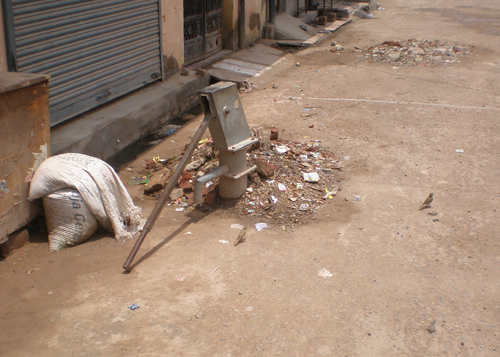
Apart from the physical scarcity of water, the imbalance between demand and supply has put a severe strain on water management and institutional systems. We take care of our needs/ demands through any means/supply possible. In the local context, richer housing societies use ground water supply to augment the municipal supply as per their water demand. Or we make personal arrangements through private hand pumps if we have to take care at individual household level among the rich or poor. This is the ‘big picture’.
What is missing in the big picture is each of us willing to take responsibility for the situation, instead of pointing fingers at others. You know the drinking water we need every day is 20 liters per capita per day (lpcd). What we all get is 60 lpcd in Delhi! So, we get more than enough water to drink and cook. That is all the safe water we need.
What we CAN do is to “create” our own water–locally by simply collecting it instead of letting it flow. Rain Water Harvesting, using recycled water in lawns and gardens are all possible ways to recharge the ground water. It cannot be done unless each of us take appropriate action for this. We in the city are blessed with neighbourhood gardens and almost every colony has its own little patch of greens. We can collect our waste water from kitchen and washing in a cavity in the ground and divert it to these gardens. It is not very expensive. The technology exists. The (Delhi) Government has schemes to support it. But the initiative has to come from you, as RWAs, institutions, etc.
What we will have in return is – control over our own water, a greener and cleaner Delhi and ultimately a replenished water table and a sustainable city.
Also Read:
Permalink
October 23, 2009 at 1:20 pm
by Aastha Kukreti · Filed under News
350.org is
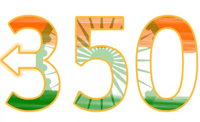
organizing a Giant 5 human formation at the Red Fort. This formation would be a part of the Global 350 with 3 is being formed at Sydney Opera House and 0 being formed at Copenhagen. The mega action would take place after the culmination of clean up drives at Qutub Minar and the Tuglaqabad Fort, cycle rallies, plantation drives and dozens of similar actions happening across Delhi, and more than 500 hundred young people would gather for the formation.
October 24 comes six weeks before those crucial UN meetings in Copenhagen. It’s a great chance to take a stand—maybe the last great chance, given what the scientists tell us about the momentum of global warming.
350.org is an international campaign dedicated to building a movement to unite the world around solutions to the climate crisis–the solutions that science and justice demand. Our mission is to inspire the world to rise to the challenge of the climate crisis—to create a new sense of urgency and of possibility for our planet.
Our focus is on the number 350–as in parts per million, the level scientists have identified as the safe upper limit for CO2 in our atmosphere. But 350 is more than a number–it’s a symbol of where we need to head as a planet.
For further information, please contact:
Pinaki- 9873935480
Snigdha Kar- 9818745466
Previously on Delhi Greens:
Permalink
October 23, 2009 at 12:33 pm
by Sampa Kundu · Filed under News
A Guinness World Record shattered last weekend when 173,045,325 citizens gathered at over 3,000 events in more than 120 countries, demanding that their governments eradicate extreme poverty and achieve the Millennium Development Goals (MDGs). The “Stand Up, Take Action, End Poverty Now!” campaign, now in its fourth year, has been certified by Guinness World Records as the largest mobilization of human beings in recorded history, an increase of about 57 million people over last year.
“The more than 173 million people who mobilized this weekend sent a clear message to world leaders that there is massive, universal, global demand for eradicating poverty and achieving the Millennium Development Goals,” said Salil Shetty, Director of the United Nations Millennium Campaign. “In particular, we have seen citizens determined to show their governments that they will hold them accountable for keeping their promises to end hunger, improve maternal health and abolish trade-distorting agricultural subsidies. They will not accept excuses for breaking promises to the world’s poorest and most vulnerable people, who have already been hardest hit by the global food, economic and climate crises they had no role in causing.”
More than 100 million people participated (101,106,845) this year in Asia alone. Currently 1 billion people around the world are hungry and 500,000 women continue to die annually as the result of pregnancy and childbirth. The vast majority of these deaths are preventable. The mobilization was organized globally by the United Nations Millennium Campaign, in partnership with a range of organizations including the Global Call to Action Against Poverty (GCAP). “Stand Up” was also supported by the entire United Nations system, with events organized by United Nations Information Centers (UNICs) across the globe.
Join this global movement and be the first generation who can end poverty.
Permalink
October 22, 2009 at 9:56 am
by Gialome · Filed under Articles

My vivid memory of Manmad–a township, due to major Railway junction in Maharashtra that I visited in the 60s–is that of early morning chaos, shouting and screaming over a common tap outside my uncle’s residence for collecting water. When I was growing up, the typical humorous short stories in my mother-tongue Marathi used to depict quarrels over common taps to collect water for domestic consumption in local communities, described as ‘Nala che Bhandan”. These stories were humorous portrayal of fights over water in local settings that began with minor issues. Jokes apart, this often led to communal tensions in real life. Typically, the water supply would last for two to three hours and water had to be collected and stored in that short span of time–one tap for twenty households.
I am sure similar scenarios exist in the villages and slums of Delhi as they do in parts of Patparganj. Delhi is an expanding city. We attract people in search of employment and new livelihood opportunities. This leads to additional population pressure and a much increased demand for fresh water. Then we settle in the city, get our families, and create wealth. Then expect to move into houses with bigger better bathrooms and taps, and an ever increasing demand for water. Typically, most of us migrated to Delhi either in this generation or in the past few generations.
This increasing water demand can be met only by a limited set of options like building more storage in dams and reservoirs, creating underground storage and transfer structures. Our city is mainly supplied by Yamuna river a perennial supply fed by the Himalayan Glaciers and we generously tap into ground water to augment it. These have yielded some positive results and also have potential for further extension. But there are inherent limitations to these strategies.
As if this was not enough, climate change has introduces a whole new dimension to the water challenge. The impact of climate change on rainfall patterns, river flows, dependent upon glacial melt and sea levels has only recently begun to be scientifically assessed with some degree of accuracy. Nevertheless, a recent report by the Intergovernmental Panel on Climate Change (IPCC) concludes that it is “very likely (a greater than 90 percent probability) that most river basins are likely to become drier leading to persistent water shortages.” Moreover, glacial melt that today supplies 80 percent of the dry season flow to the major northern rivers including Yamuna, could see this contribution reduced to 30 percent over the next 50 years, i.e in our life time.
So the possibility of a 24/7 water supply is going to remain a dream for most of us and we need to think of a new strategy to ensure that we have enough water for our consumption in the future. So what next?
Permalink
October 21, 2009 at 1:13 pm
by Aastha Kukreti · Filed under Events
Toxics Link’s Environment & Health Public Lecture Series

The most popular lakes of NCR have disappeared. The 2 billion year old water bodies of the Aravallis – Surajkund, Badkhal and Damdama, have all dried up.
This film looks at the nexus between the corrupt bureaucracy with the construction and the mining mafia. With exclusive bytes from Retired Forest officers, Environmentalists and Scientists, we piece together the whole story behind the current mess. This film opens with a few short interviews, which talk about what led to the disappearance of the lakes due to illegal & irresponsible mining and construction of farm houses in the notified forest area of the Aravallis. We talk to experts on the principle of sustainable mining and through their comments, the land-mafia-admin-police-miner nexus comes out, and the utter helplessness of the situation gets revealed.
The latter part of the film explores the realm of PILs filed by Magsaysay award winner Advocate M. C. Mehta that led to the court banning all mining operations in the area. The Haryana government, apparently oblivious, to the ruling went ahead with inviting bids for mining leases for Sirohi and Khori Jamalpur mines.
The climax questions the Haryana Government’s claim of bringing back water to its lakes before the Commonwealth Games without any concrete plans for the same. The residents of the area — who have seen the tourist flow getting reduced to a trickle over the years — complain that no effort was ever made to maintain the water flow to the historical Surajkund which is now a fleeting shadow of its past.
An alarm had been sounded in the hydrological report submitted by the Ministry of Environment in its affidavit before the forest bench of Supreme Court in August last year. It had mentioned that these used mining pits were found ‘‘filled with water’’ leading to ‘‘massive evaporation of groundwater’’ — about 8.86 lakh ccm of fresh water.
The film ends with a ray of hope in spite of apparent ecological disaster and offers a way-ahead in devastated areas.
Speakers:
- Ms. Ishani K Dutta – Director, The Land Of Vanishing Lakes
- Mr. R. K. Srinivasan – Senior Research Officer, Centre for Science and Environment
- Mr. R. P. Balwan – Retd. Forest Officer, Haryana Govt.
Date: 23rd October 2009, Friday
Time: 6:30 p.m.
Venue: Conference Room I, India International Centre, Lodhi Road, New Delhi
(In collaboration with India International Centre)
For further information and RSVP, please contact:
Pragya Majumder – pragya@toxicslink.org
Tel: 24320711, 24328006
Email: info@toxicslink.org
Permalink
October 21, 2009 at 12:55 pm
by Govind Singh · Filed under News

Looks like we still have time, or do we?
On 17th October 2009, the President of the island nation of Maldives called for the world’s first ever underwater Cabinet Meeting. In the meeting, the President, Vice President, and the entire cabinet of Maldives signed a declaration calling for concerted global action on climate change, ahead of the UN climate conference (COP) in Copenhagen.
And even as the world prepares for this grand climate meet, a large part of South India went under water only a few weeks back. And while talks have already begun on coming up with an equitable deal and the very fear that there may be none, over 300 people lost their lives while millions have been displaced and missing in that global warming related freak weather event, predicted well in advance by the IPCC in its Fourth Assessment Report in 2007.
The Earth will never come to the negotiating table and the earth will never die. Humans will and thus the need to understand that very strong emissions reductions of the magnitude emitted by leading Northern countries is not just the only way but also not-negotiable.
Image Source: Telegraph and PresidencyMaldives
Permalink
October 15, 2009 at 11:41 am
by Govind Singh · Filed under Opinions
Deepawali is the festival of lights and celebrations!
Let us make sure it is an enjoyable experience for every living being as much as it is for us. After all, there is no joy greater than than the joy of making others happy!
This Diwali, BE THE CHANGE! Do Not burst crackers and make others aware about the adverse impacts it has on ‘our common environment’.
The environmental impact of bursting of crackers are both visible as well as not so apparent. While the noise pollution caused by the crackers is highly disturbing even for humans (young and old alike, very dangerous for pregnant women and infants), they at least understand and expect the noise.
Animals are caught unaware, and get scared as well as very disturbed by the noise. While we know the impact on domesticated animals such as dogs, who can be seen running around to the central parts of homes or in cupboards..and the stray ones just running around here and there…the impact on our winged friends is little understood.
Birds are the worst hit owing to just the noise pollution part of the bursting of crackers. The pungent smoke only adds to their misery and impacts there entire body system. This also has long term effects that need to studied…and also leads to a selective selection of some birds (like pigeons, who’s excreta leads to asthma) and the disappearance of certain other birds like the common sparrow.
Diwali Greetings from Last Year:

This man-made selection both disturbs the urban ecology and also causes discomfort for an extended period of time. So, one day of crackers bursting actually leads to an year full of misery. Light pollution is another aspect of Deepawali that often goes unnoticed.
The bursting of crackers also adds to the suspended particulate matter (SPM) in the city. The SPM value is almost doubled on the Deepawali night than on any other day. This is, of course, a nightmare – a disaster for patients suffering from lung diseases including asthma. This also adds on the pollution load of the city and the SPM often remains accumulated on the leaves of plants for days after Deepawali. This reduces the area available for photosynthesis and brings down the ability of green plants to feed themselves.
Everything else, from the way the crackers are made (usually by small children), to the polythene packaging material (owing to the large consumption pattern) and the potential hazard contributes to the pollution related to Deepawali and affects all life forms in the city.
The toxic chemicals that make up the explosives and lights are released into the atmosphere with just one large bang…and while the festival is actually about celebrating life and glory…strangely…we do that by releasing poison in the air which is manufactured with processes that are no less lethal.
Tips to Readers for a More Enjoyable Diwali:
- During the festival-shopping, think before you buy, think what you are buying.
- Instead of crackers, buy yourself a gift–something you have been wanting for long, buy few more for your friends and relatives.
- Remember to keep your ecological footprint in mind when shopping for the festival. Buy only what you think is really really important.
- Avoid plastic bags when you are buying anything. The chance that they would be disposed off by burning are more around this time.
- DO NOT burst crackers near a green space or even a park. If you must, choose an open area for this.
- Last, but never the least, remember Deepawali is (and should be) about lights and celebrations, not pollution and death.
Permalink
October 15, 2009 at 11:30 am
by Gialome · Filed under Opinions
May this Diwali be a celebration of vitality and abundance to all of us. Let me be authentic about who I was before I started writing in this blog. I tended to look at vitality as something that is limited to what I could provide and the planet we live on, to have limited resources. Therefore the constant concern for me was, what would create the necessary energy? The easiest option I chose was always to nap or sit before the TV surfing channels so that I would have enough energy to get into action. I realized that no amount of rest and recreation was enough and I became lazy and bound to home.
Fifty Blogs down the road (yes! unbelievable isn’t it?) I realized that you are the creators of my vitality. With the Blog I am committed to creating a possibility of a green and clean city while still maintaining its unique cultural heritage. Participating in your lives and creating the future of our city, is what keeps me vital.
The possibility for the future city is right here, right now, moment by moment. It is the actions I take of writing the blog or talking to people in social gathering or with residents of my society with whom I share my ideas and listen to their ideas, support them to maintain a clean and green society is participation.
It does not take much, simple actions like walking to the market place or taking the Metro, or a cycle rickshaw if I have loads to carry. It is these little things that we do every day that matter in making the possibility of a Green City: real and alive. After all this is our city and we should support each other to create something new, green and vital.
Vitality is abundant. Participate in the game of life. When you are up to creating something, that is when you are most vital. So participate in celebrating Diwali: go visit people. Enjoy. And be happy.
Permalink
October 8, 2009 at 2:15 pm
by Aastha Kukreti · Filed under News

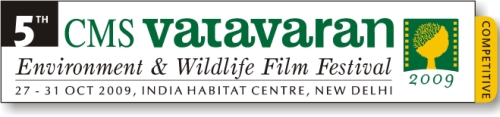
CMS VATAVARAN is India’s premier biennial competitive and traveling Environment and Wildlife Film Festival. It was initiated in 2002 towards raising awareness about environmental issues. The CMS Environment Forum and CMS VATAVARAN have ushered in a fresh green global consciousness on an extraordinary scale using environment forums and films. The objective is to increase space for environment issues in mass media and evolve a nationwide environment outreach framework.

Every year the festival is growing in terms of the quality of films recieved as well as the number of entries. This year a total of 366 entries have been received 366 including 276 entries from 20 different states of India. Also, 90 International entries have also been received from 23 countries.
The film festival will be organized from October 27-31, 2009 at the India Habitat Centre, New Delhi under the theme Climate Change and Sustainable Technologies.
This five day long extravaganza will showcase best of environment and wildlife films in addition to a host of seminars, workshops and panel discussions on several contemporary issues related to environment, climate change, sustainable technology, eco-tourism and several other issues.
Click here to Register for CMS-Vatavaran-09
For further information and to participate, contact:
Mr. Narender Yadav,
Manager-Communications,
M: 098999-79160
E mail: narender@cmsindia.org
Previously on Delhi Greens:
Permalink