
Right to Clean Air and Pollution Crisis in Delhi
The Supreme Court has recognized the right to clean air as part of the fundamental right to life under Article 21 of the Constitution. But why does Delhi continue to suffer?
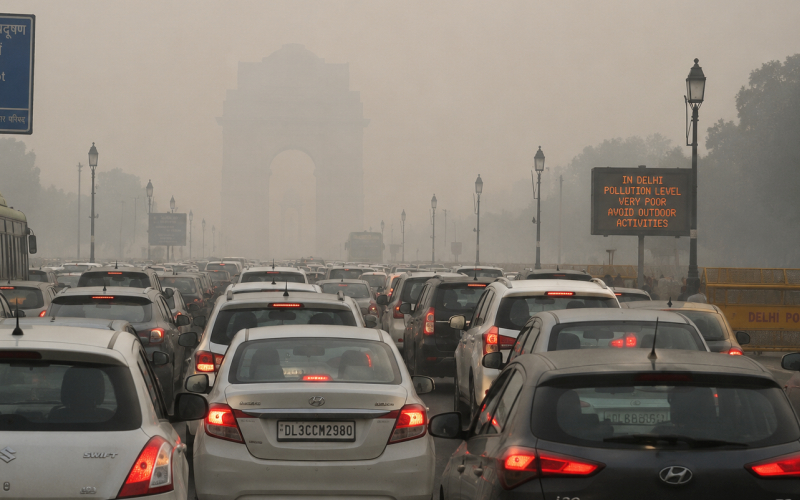
Winters in Delhi were once known for the fog. In recent decades, the fog has turned into smog. Smog is a mixture of fog and pollutants like vehicular exhaust, industrial emissions and dust. In 2025, air-quality in Delhi repeatedly remained severe and PM2.5 (particulate matter, tiny particles that can enter deep into lungs and bloodstream) exceeded safe levels many times during the year. Schools were shut, and emergency measures were imposed. Yet for millions, especially outdoor workers, avoidance was not an option.
Right to Clean Air as a Fundamental Right
The Constitution of India does not explicitly mention a Right to Clean Air. Article 21 of the Constitution has been judicially interpreted by the Supreme Court to include the right to a clean and healthy environment. The turning point came in Subhash Kumar v. State of Bihar (1991), where the Court stated that Right to Life includes the right to enjoy pollution-free water and air. This principle was reaffirmed in cases, including MC Mehta v. Union of India (1986) and Arjun Gopal v. Union of India (2018).
Legislative Framework and Regulatory Measures
Legislation that address air pollution include:
- Air (Prevention and Control of Pollution) Act, 1981 amended in 1987 to strengthen Pollution Control Boards
- Environment Protection Act, 1986 (EPA) and Environment Protection Rules 1986, enacted after the Bhopal Gas Tragedy, to regulate environmental standards
- Commission for Air Quality Management in National Capital Region and Adjoining Areas Act, 2021 creating the CAQM to coordinate anti-pollution measures across Delhi-NCR
- The Jan Vishwas (Amendment of Provisions) Act, 2023 amended the provisions of both the Air Act and the EPA by decriminalizing certain offences and revising penalties
- The National Clean Air Programme (NCAP), 2019
These measures empower authorities to regulate emissions, monitor air quality and impose penalties on polluters. The Central and State Pollution Control Boards are responsible for monitoring pollution levels and enforcing environmental regulations; CAQM coordinates pollution control measures across Delhi NCR.
Judicial Interventions and NGT
A unique case that has shaped environmental governance is MC Mehta v. Union of India (1986). Over the last four decades, the Supreme Court:
- Mandated CNG conversion of public transport
- Ordered closure or relocation of polluting industries
- Introduced Graded Response Action Plan (GRAP) in 2017 which provides emergency measures based on pollution levels in Delhi NCR
- Helped phase out leaded petrol
These interventions improved air quality but were not adequate due to rapid urbanisation, stubble burning, rising vehicular emissions and inconsistency in implementation. Recently, the Supreme Court criticized authorities like CAQM for being “unserious” in tackling pollution, directed public disclosure of pollution sources and called for long-term solutions instead of seasonal responses. Although the courts can issue directions, implementation ultimately depends on the executive branch.
The National Green Tribunal is a specialised environmental tribunal established under the National Green Tribunal Act, 2010. It deals with environmental compliance and ensures faster environmental adjudication. NGT has monitored air pollution compliance and raised concerns like inaccurate air-quality reporting and poor maintenance of monitoring systems.
The Gap between Law and Lived Reality
Despite regulations and judicial interventions, Delhi’s air crisis has persisted. This gap between legal rights and lived reality has increasingly pushed citizens to act. Environmental rights are no longer abstract legal ideas, but deeply felt public demands. In 2025, protesters gathered at India Gate demanding action and holding signs like ‘Our right, clean air’. Some were detained, reflecting both the urgency of crisis and tensions around public dissent.
What are the factors due to which the problem still persists?
Delhi’s pollution crisis results from multiple overlapping factors including:
- Vehicular emissions
- Construction dust
- Industrial pollution and coal-based energy
- Stubble burning in neighbouring states
- Seasonal weather patterns that trap pollutants
During winter, temperature inversion traps pollutants close to the ground, worsening air-quality significantly.
Three key factors behind persisting air pollution in Delhi are:
- Weak enforcement since regulatory bodies such as the CPCBs, SPCBs often lack adequate resources or suffer from misguided political will.
- Fragmented governance since air pollution is not caused within the city alone. Stubble burning, emissions from vehicles and industries, thermal power plants, construction activities across neighbouring NCR states contribute as well but governance remains divided across states leading to delayed or diluted action.
- Reactive policy approach since measures like GRAP are short-term emergency responses rather than sustained structural reforms.
Way forward
There is a need for more effective recognition and implementation of the Right to Clean Air in India. Focus most be on:
- Higher penalties in case of non-compliance by industries and construction projects, especially in case of repeat violations.
- Long-term urban planning including stricter regulation of construction dust, improved waste management systems and creation of low emission zones in highly polluted areas.
- Preventive environmental governance focused on sustainability rather than emergency responses.
Citizens must also play an active role by reporting violations on Government platforms, seeking transparency through RTI applications and adopting environmentally conscious choices including choosing public transport and not burning waste.
The law provides some recognition of clean air as a fundamental right yet millions continue to breathe hazardous air daily. The judiciary has expanded and protected this right but courts cannot replace governance. Until environmental laws are implemented with coordination and accountability, the constitutional promise of the right to clean air will remain obscured behind Delhi’s smog-filled sky.